Friday, February 19, 2010

This week in mandatory ugliness


Often in class I create little hierarchical charts on the fly in MS Word. In Word 2003, I am able to make a chart like the one on the right while I am explaining it. In Word 2007, the same chart comes out like the one on the left, and there is no way to remove the double balloons. (Or if there is, I can't find it.) The result is that more visual space is taken up with junk that carries no information, and there is less room to put in more explanatory text.

GRRR.

Thursday, February 11, 2010

This week in stupid

Its been a big week for stupid. Here are some highlights.

An article on Read Write Web features the words "facebook" and "login" in the headline and deals with some trendy topics, so it gets to be the number 1 google hit for "facebook login." The comment thread then is flooded by people who think they are at the facebook login page and are complaining that they don't like the new interface.

A US college student was detained and interrogated by federal agents at an airport because he had English/Arabic flashcards.

The Virginia legislature debates a bill that would ban employers from putting microchips in their employees against their will. No business is even considering doing this, but Delegate Mark L. Cole explains that people worried about this because the Mark of the Beast described in Revelations might actually be a microchip installed by a one world government to control commerce.

Via Apostropher, Chris G, and minivet.

Wednesday, February 10, 2010

Same class, two sections, two completely different sets of evaluations


I taught two land-based sections of ethics last semester, one right after the other, using the same syllabus and lessons plans, and the course evaluations could hardly be more radically different. The whole thing is a good case study in interpreting student evaluations.

The chart above is just one measure of the difference. In the 10 AM section, a big majority (70%) of the students strongly agree that I was an effective teacher. For the 11AM section, few strongly agree that I was effective, and some even disagree with the idea that I was effective at all. (Note, there is a strong bias toward positive evaluations on this question. You simply won't see evaluations that are the exact inverse of my 10AM question unless the teacher was, like, drunk in class.)

The written comments paint a bigger picture of the 11AM section. I got twenty seven comments, and only four were positive. This was actually the first page I saw when I opened the envelope, and the whole thing hit me like a sack of bricks. They hated me, they hated the textbook, they hated the assignments, they hated the syllabus. Almost everyone used the word "confusing." It gave me one of those "Have I really chosen the right career?" moments. The 10AM section, on the other hand, only had four comments, all of which were blandly positive.

A typical response from teachers here would be that course evaluations really don't tell you anything, and this is evidence for that. Responses are all over the map, and they only reflect the idiosyncratic responses of students, who don't really know what is good for them anyway. But this would be a big mistake.

Thing is, I knew the 11AM section wasn't going well while it was happening. The students were so unengaged that I had the cameraman move to the 10AM section so we'd get better video for distance learning. I didn't realize how bad it had gotten, I think, because the good earlier class put a halo over the later class. But I knew there was a difference. The negative evaluations for the second section reflected a real difference in student experience and student learning.

Here are the real lessons I take home. The first is something every customer service representative knows: unhappy customers give a lot more feedback than happy ones. I don't have two pages of effusive comments about how great I am from the 10AM section, even though they all checked that I was a good teacher.

The second is that you can't design a course that will appeal to all students. Is the design of my ethics course sound? It is for some students. I suspect that this course, in particular, works for students who were better prepared for college. One positive review from the 10AM section said "Its challenging in a very good way." The wave of negative reviews from the section section all said "confusing" and "too advanced for an introductory class."

Ideally, you would respond to this situation by tailoring the class to fit the students, so that if you see that a section is floundering, change the syllabus. But this is a lot harder to do when you have, say, 100 students in three sections of ethics, plus another class or two. To keep your own workload manageable, you need to keep all the sections doing the same material.

Another observation is that classes tend to consolidate around an opinion of you. If any one of the dissatisfied students in the 11AM section were moved to 10AM, they would have softened their critique, because they would have seen other students responding positively, rather than having their negative opinions reinforced.

There are definitely things I'm going to change about the class. The negative comments are far from useless. They also hurt a lot, too. I had to buy some junk food after reading these. I also needed to write this post to put things in perspective.

Tuesday, February 09, 2010

Never doubt that slippery slopes can be very very real

A Dutch group is pushing for legalized physician assisted suicide for people over 70 who are "tired of life."

Oddly, part of their argument is that the initial decriminalization of euthanasia in The Netherlands did not lead to any worse consequences: Says Eugène Sutorius (63): "It was thought to be the first step on a slippery slope that would lead the medical profession to lose its integrity. But I have seen nothing of the kind happen."

Apparently, since the first step down the slippery slope didn't lead to any other steps down the slope, we can go ahead and take another few steps down the slope.

At the bottom, at least to my mind, is euthanasia as a treatment for depression.

spin fail

LC3 has put out a flier for those interested in "Music and Theater Careers" that tries so hard to be optimistic that it includes this: "Many openings will also arise out of the need to replace those who leave the field each year because they are unable to make a living solely as musicians." That's right: so many people are fleeing the business, that it has to be a good place to look for openings. Also, wouldn't the jobs that open up be basically guaranteed to be ones where you couldn't make a living solely as a musician?

Thursday, January 07, 2010

Dream in four parts

Vignette one: I have borrowed a train

I have borrowed a train and need to return it before daybreak, when the people who actually use it will need it. The problem is that I do not know where I am supposed to return it to or how to drive it. I am also aware on some level that I did not actually get permission to borrow the train, but at no time during the dream do I think, "I have stolen a train." The landscape in front of me is lightly wooded and hilly, and probably suggested to me by one corner of the campus of Stuffwhitepeople Like University, where I used to teach. The train tracks go up and down the hills and around in a complex pattern, and I am at the top of the tallest hill. If I start the train down the hill it might roll around to the right location, like I was pushing wooden trains around on the kids' train table. But where I am trying to get the train to go? Suddenly, I realize the train automatically returns to the station, like the Roomba returning to its recharging stand. I am safe. But...

Vignette two: Acid zombies heart BitchPhD

There are men at the station wearing T-shirts that say "I Heart BitchPhD." I am aware that they are wearing these shirts ironically. The men have an acid that when they spray it on you, continues to eat away at your whole body until there is nothing left. They spray my left arm. Soon I will die. I am aware that the men are someone doing this as a theatrical critique of liberal politics. Now lots of people have been sprayed and we are in an open field. If a sprayed person touches another person, they spread the acid, giving he other person a death sentence. I, like most people, avoid touching anyone. But some people come together as couples, smearing each other with their acid covered bodies in an effort to die quicker. This is looking like a good option to me.

Vignette three: Acid rain

I am back at the train station. The men are now dressed in police uniforms. They have a device that looks like a white prism. If you jump into it, you are instantly disintegrated and a flash of light sends you into the sky. The policemen are jumping into it to avoid slow death by acid. They see me and throw me in. I am grateful.

But once the acid people are in the sky, they fall down like rain. I am cowering in the entryway to an office building, to avoid the fatal rain, but the rain is dissolving the building. I go deeper into the basement of the building. There are lots of people all over, but no one can decide what the best shelter will be. I am in a shopping plaza. I am at the beach. The world will end.

Vignette four: The movie is over, but I am still here

It is now obvious to me that this is a movie, what with the overtones of zombies and apocalypse. The credits roll, thankfully. But I am still here. What is going on? I push behind the movie screen onto the stage. There are props and flats around. Will I go back to the zombie world? I push behind another wall. And another. Then I wake up.

Friday, December 25, 2009

Tuesday, December 22, 2009

My Holiday Writing Project: Smashing Perverse Insentives

My goal this break is to revise For All x, a logic textbook made available free under a Creative Commons license, so that it is appropriate for my community college students. Textbook prices are salt in the wounds of students who have trouble paying from college, but right now teachers have no pressing reason to assign cheap or free textbooks, since they don't have to pay for them. (The economists call this kind of situation a "perverse incentive.") Most free logic books are written for geeks by geeks and aren't useful for the sort of student who is hurt most by textbook prices, so I think my project will help more than just my students.

I'm already running into problems, though. The changes I want to make are fairly basic: I want to rearrange the order the material is presented in so that more of the basic stuff comes first, and then I want to create more exercises for that basic material. (I'm just calling my version of this text a "remix.") But simply moving around text is turning out to be difficult. Magnus wrote the whole thing in LaTeX, which I don't know, so I've been opening the files in MS Word, replacing the formatting tags with formatting in Word, and then making the alterations I want to make. I was then going to convert the whole thing to a .pdf and send it to Kinko's to create $3 coursepacks for my students. Getting all the formatting straight is a big pain, though. Which leads to questions

Should I just learn LaTeX? Can I do this over the break and get the text ready in time for my stduents? Is there a reader I should use to show how the marked up text will appear in print? How do I put this all in a form that Kinko's will accept?

If I don't learn LaTeX right now, how do I get my formatting to look like Magnus's? How can I figure out what fonts he is using given the LaTex files or a .pdf file? If I'm just approximating his formatting, what fonts should I use?

These are just my initial worries. I haven't even begun to do things like generate new exercises yet. I'm still hung up on the mechanics of producing a book. Anyone have advice?

Tuesday, October 06, 2009

Worst science reporting ever.

Be sure to click through to read the story. Remember, science reporting gets really bad, and this is the worst ever science reporting.
Worst science
Originally uploaded by perca fluviatilis.

Friday, October 02, 2009

More on Issue 2

My colleague Ben and a woman from the Ohio Farm Bureau have raised some interesting points about issue 2. I'd like to respond to them publicly because in order to clarify some misconceptions.

The Oversight Board Would Be Undemocratic

Ben points out (on Facebook) that in general, oversight boards are a good thing, and a board that overseas farm animal welfare could be good for animals. While this is true in general, it is not the kind of board we are looking at here. The goal of this board is explicitly to keep decision making about animal welfare in the hands of the agriculture industry, and not in the hands of voters, by making a change in the state constitution.

The vote Yes campaign is being run by Ohioans for Livestock Care. The flyer I have from them begins "Ohio farmers know best how to care for their flocks and herds." This tagline is repeated at in an announcement on the Ohio Farm Bureau website about a Yes on 2 rally. The content of the ballot issue is perfectly in line with this goal. Eleven out of the thirteen members of the commission would come from within some aspect of agriculture (farmers, farming organizations, deans from agricultural schools, etc.) There be one person representing consumers and one representing animal welfare, but the animal welfare representative cannot come from national organizations of animal activists. This last point is crucial, because the real aim of this ballot issue is to block efforts by the Humane Society of the US. (More on them soon.)

Now wait, you might ask, don't farmers know how best to treat their animals? Why shouldn't the oversight board be dominated by the farmers themselves. Well, well obviously farmers have first hand knowledge of the lives of their animals, but they do not have an interest in the welfare of those animals. Their interest is in maximizing profit, and this means raising veal, chickens and brooding sows in boxes so small the animal can't turn around. In order for everyone's interests to be honored, decisions made about animal welfare have to be made democratically, and include people who can speak for the animals.

Ballot Issue 2 is an amendment to the state constitution. It is fundamentally about taking power away from the legislature, power that it now has under the constitution, and giving it to industry.

The Oversight Board is Aimed at Blocking a Good Legislation.

Everyone involved in this debate admits that the driving force behind the issue is a recent California law that animals be kept in pens large enough to "to lie down, stand up, fully extend their limbs and turn around freely." The law was passed as a ballot initiative in California and was backed by the Humane Society of the US. Afterwards, the HSUS met with Ohio lawmakers to discuss bringing a version of it here. The lawmakers response was to immediately put issue 2 on the ballot, so that they would have the power to enact any such laws.

The California law effectively eliminates three industry practices. First of all it would eliminate veal crates. People who eat veal like the pale tender meat that comes from anemic calves. Starting in the 1950s, farmers have learned that they can produce a lot of this sort of meat by keeping calves in pens where they are unable to turn around, groom themselves, or lie down while extending their legs and feeding them a liquid diet of milk powder, vitamins and growth hormones. The only justification for doing this is the consumer's preference for pale, tender, anemic meat. Second, the law eliminates battery cages for egg laying hens. To maximize profit, hens are again raised in stacks of wire mesh cages, with each bird having an area about the size of a piece of paper to move around in. Again the only motive here is profit. The third practice, crates for brooding sows, is a little different. Pregnant pigs are generally kept in gestation crates because they are extremely ornery and likely to fight

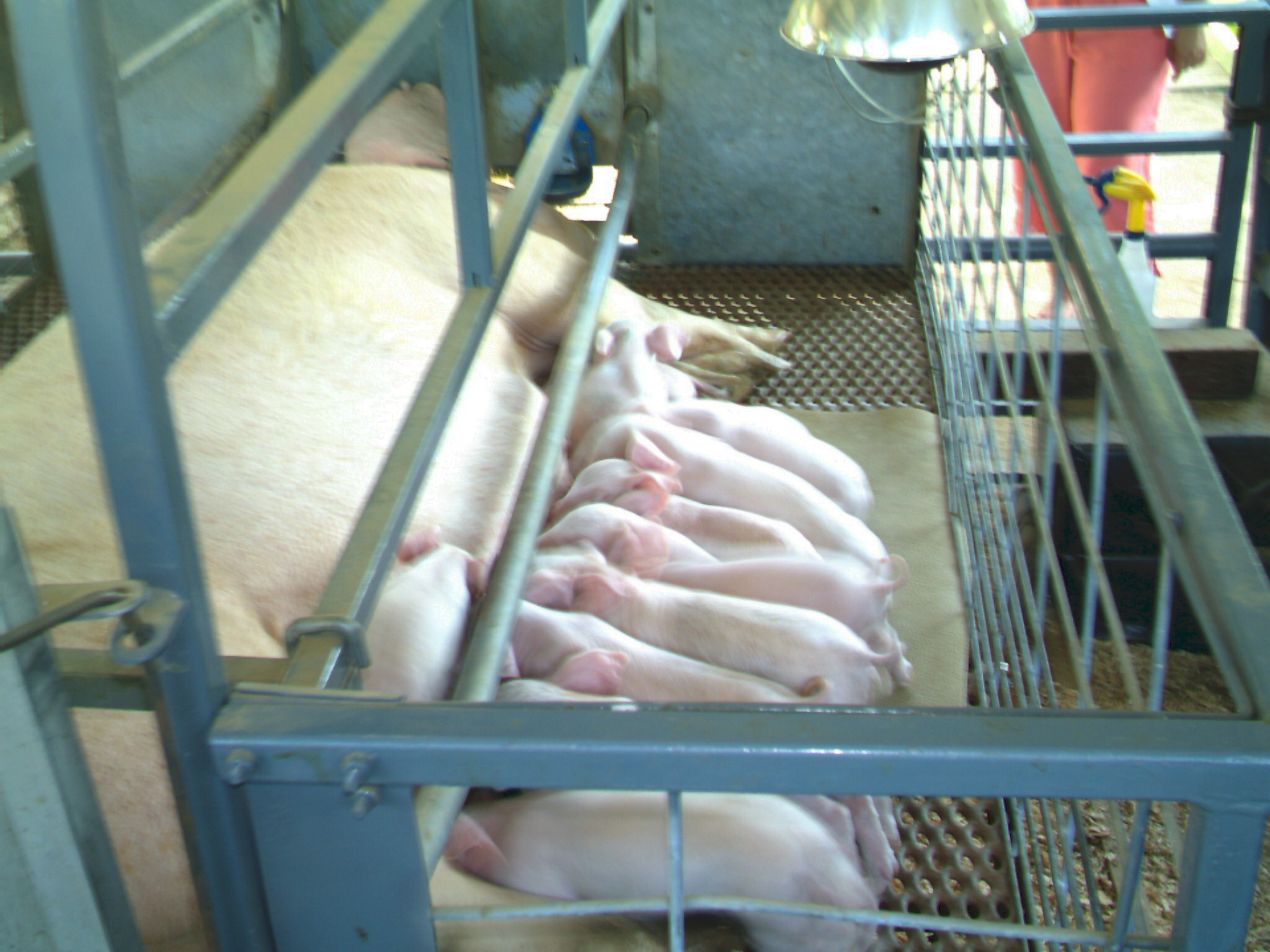
once the big gives birth, they are kept in farrowing crates like these, so the piglets can nurse while the mother remains immobile

here the worry is that the nursing pig would roll over on her young, or perhaps eat them. To my knowledge, though, there is no actual evidence that this happens. Furthermore, there is no evidence that any crazy behavior by the pig isn't actually brought by other aspects of their environment, like poor diet, lack of access to the outside, etc. Certainly in the wild, the pigs must be able to raise some of their offspring to adulthood. So again, we are left with little justification for treatment that creates incredible suffering.

The Personal Attacks
I originally got on to this issue because someone from the Ohio Farm Bureau left some flyers in support of Issue 2 at our office, along with a basket of fresh bell peppers. I sent around an email to the rest of the department about the issue, and shortly thereafter, the woman from the Farm Bureau wrote me back. The first thing she did in her email is attack the Humane Society of the United States, including sending a flyer about them produced by the food industry organization the Center for Consumer Freedom.1

Some of her complaints are reasonable. The name of the organization misleadingly implies that they run local animal shelters, when in fact most of their work is activism on the issue of farm animal welfare. Other attacks were false, including that the HSUS seeks to end all animal agriculture. From their policy statement: "The HSUS supports those farmers and ranchers who give proper care to their animals, act in accordance with the basic ethic of compassion to sentient creatures under their control, and practice and promote humane and environmentally sustainable agriculture." Still other complaints made by the woman from the Farm Bureau and the Center for Consumer Freedom are things I can't evaluate, like accusations that HSUS mismanaged charitable donations and has a spokesman for a terrorist organization on its board of executives.

Well, as a teacher of critical thinking, I am duty bound to remind you of the existence of the ad hominem fallacy. The moral character of the HSUS is simply not relevant to whether Issue 2 is a good constitutional amendment.2 Bad people can argue for good causes and good people can argue for bad causes.

Annoyingly, it looks like I'm going to be writing more on this in the future. Next up: finding my copy of Bernie Rollin's Farm Animal Welfare and researching the European laws on gestation & farrowing crates.

1. For the record, she sent me the flyer to correct an erroneous statistic about HSUS fundraising she had given in her first email. She didn't repeat the accusation of terrorism herself.

2 Although it is worth noting that The New York Times describes the HSUS as the "least radical" of all the animal rights groups.