Showing posts with label theragatha paper. Show all posts

Wednesday, March 18, 2009

from the Miscellany section of Characteristics

Were we in a disinterested view, or with somewhat less selflessness than ordinary, to consider the economies, parts, interests, conditions and terms of life which nature has distributed and assigned to the several species of creatures around us, we should not be apt to think ourselves so hardly dealt with. But whether our lot in this respect be just or equal is not the question with us at present. 'Tis enough that we know "there is certainly an assignment and distribution: that each economy or part is so distributed is in itself uniform, fixed and invariable, and that if anything in the creature be accidentally impaired; if anything in the inward form, the disposition, temper or affections be contrary or unsuitable to the economy or part, the creature is wretched and unnatural.


Judging by google search, the word 'disinterested' doesn't seem to come up in aesthetic contexts in characteristics. Also, Shaftesbury seems far more concerned with theodicy than aesthetics.

Comparing Shaftesbury to the Buddhist nature poems I consider in my essay is interesting. Both works assert that by taking up a selfless frame of mind in the presence of nature, one can attain sacred knowledge. But how they conceive the knowledge is very different, because of the different attitudes toward suffering in the two religions. Shaftesbury sees suffering as part of a just larger order, and links it to punishment of those who do not contribute to the order. The Buddhist view cuts suffering off at the root, so that the selfless person simply ceases to experience suffering.

lets try this quote.

New forms arise, and when the old dissolve, the matter whence they were composed is not left useless, but wrought with equal management and art, even in corruption, Nature's seeming waste and vile abhorrence. The abject state appears merely as a way to some better. But could we nearly view it, and with indifference, remote from the antipathy of sense, we then perhaps should highest raise our imagination, convinced that even the way itself was equal to the end


So for Shaftesbury, disinterestedness meant looking beyond the narrow good of the self, or of any subset of the whole universe. Once you view the world sub specie aeternitas you can see both divine beauty and divine goodness.

Perhaps I should get the book through ILL. Or maybe just buy it. I don't know which would be faster.

Shaftesbury's notion of aesthetic disinterestedness

One reason one might be reluctant to compare aesthetic disinterestedness with Buddhist nonattachment is that the former is generally thought of as a secular concept while the latter is explicitly religious. However, aesthetic disinterestedness has been linked with religious ideas since the beginning. Shaftesbury's primary aesthetic interest was in the religious contemplation of nature, which he felt afforded a view into a greater order than any human art. Thus in The Moralists the character Philocles begins an invocation of the beauty of nature like this.
Oh glorious nature! supremely fair and sovereignly good! All-loving, all-lovely all-divine! Whose looks are so becoming and of such infinite grace; whose study brings such wisdom and whose contemplation such delight; whose every single work affords an ampler scene and is a nobler spectacle than all which art ever presented!
Disinterestedness enters the picture because seeing this divine order requires one to set aside earthy interests.
Since by the, or sovereign mind, I have been formed such as I am, intelligent and rational, permit me that with due freedom I may exert those faculties with which you have adorned me. Bear with my venturous and bold approach. And since nor vain curiosity, nor fond conceit, nor love of aught save thee alone inspires me with such thoughts as these, be thou my assistant and guide me in this pursuit, whilst I venture thus to tread the labyrinth of wide nature and endeavor to trace the in thy worlds.
Arg, that didn't quite say what I want it to say. The passage right after might be better, but I am reading the book in google preview, and can't get the next pages. In any case, I think Shaftesbury's sub specie aeternitas approach to aesthetics, probably makes him disinterested and cognitive, rather than disinterested and noncognitive, as I had had him.

I'm not going to get this done over spring break. My head hurt so much this morning I had to take a nap. I'm having trouble focusing. Winter has returned and the kids are back inside making noise. Maybe I should focus on classwork. Maybe I can keep writing a little bit every day once classes start again. Actually if this is going to get done, I'm going to have to.

Tuesday, March 17, 2009

means-ends rationality, desire, and non-cognitive mental states.

The spring day has put what seems like a dozen kids on our lawn. I think two of them are mine. I think there adults out there keeping track of everyone, but I'm not going to worry about it, I'm here to write. And I'm worried that the way I have set out the problem of my paper will force me to use the term "non-cognitive mental state," which might be a straight oxymoron.

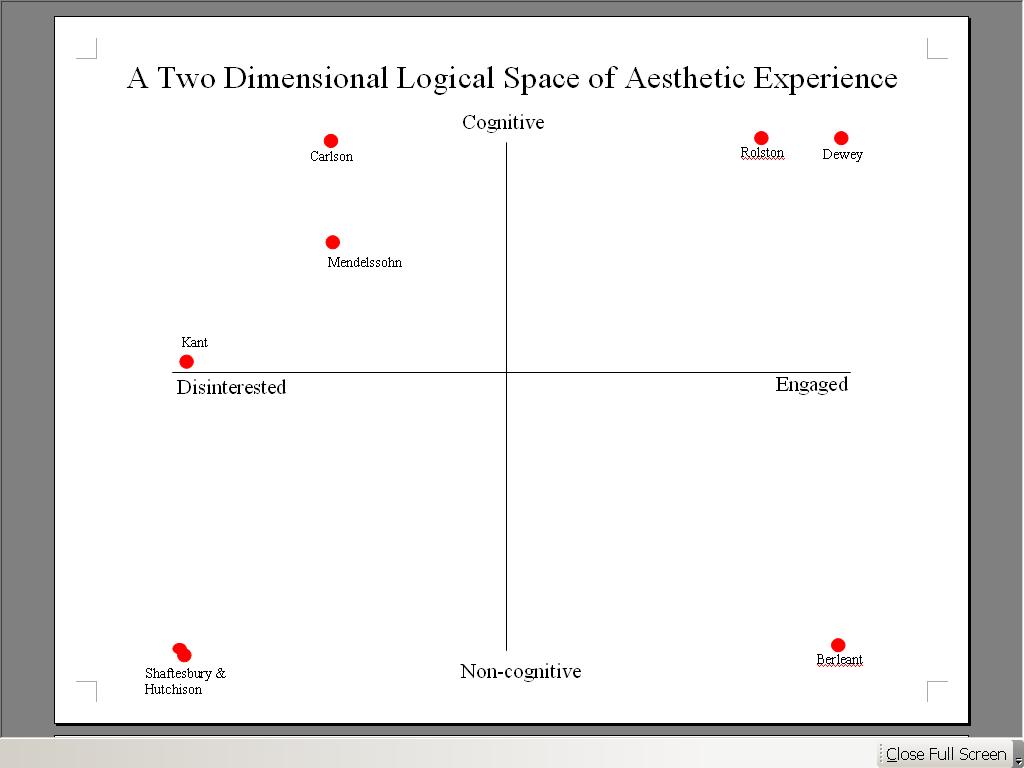
I want to assert that aesthetic disinterestedness, as it has been described in western philosophy since the 18th century, and nonattachment, as it has been has been described in Indian and Buddhist philosophy for thousands of years, name similar mental states. Here's the problem: in talking about aesthetic experience of nature in the western tradition, I distinguished two axes of disagreement. People have argued over whether aesthetic experience is "disinterested" or "engaged" and whether it is "cognitive" or "noncognitive." The cognitive/noncognitive dispute is over whether the aesthetic appreciation of a natural environment, should be guided by ideas from history and natural science or whether it should be free of all guiding narratives. The disinterested/engaged debate is over whether one should feel a personal stake in the object of aesthetic contemplation or view it from a detached perspective. You can then map the position in the debate over the aesthetics of nature onto a two-dimensional space, like this.

A two dimensional logical space of aesthetic experience

I love making little diagrams like this. I'd like to populate this one with a lot of thinkers and then actually publish it with my article, but it probably wouldn't be scholarly enough.

In any case, I want to put Buddhist nonattachment in the lower left, as a disinterested, noncognitive state. This sounds right if you talk about the dots as "experiential states." But it does't work as well if you say they are "mental states", which is what I did in the last post. Noncognitive mental state doesn't sound right. I suppose I should just change "mental" to "experiential" when I work the material in the last post into the actual essay, but that might make the references to meaning in the head awkward.

Drop the problem and move forward.

We need to zoom in on the lower left corner, look at the notions of disinterestedness that have been held in the western tradition and how they relate to noncognitive experience. Then we need to do the same for nonattachment. Lets start with disinterestedness.

Shaftsbury

kids need reading to

ok, I'm writing again

I went with Caroline down to the Rock Beach, a small stretch of sand, garbage, driftwood and stones along Lake Erie near our house. We go to hunt for pretty rocks and "sea glass" (really fragments of old bottles that have been worn smooth by the water.)

Ok, back to work. The idea of nonattachment developed during the axial age of Indian philosophy, from around 800 BCE to the beginning of the common era, an age which saw the writings of the Upanishads and the Bhagavad Gita and the lives of the Buddha and Mahavira. It cannot be traced to particular thinkers interested in promoting particular ideas, the way disinterestedness can, and it was not intended as an account of a single aspect of experience, such as beauty. Instead it was an integral aspect of a program for attaining complete spiritual liberation.

Despite the radically different origins of the two ideas, I maintain that they describe similar mental states. In each case, we are looking at a suspension of means-ends rationality and some form of putting desire on "hold." Admittedly, mental states are a bitch to individuate, and clearly depend on factors that are not "in the head," including social and physical reality (cite annoying twin earth-type research here.) You cannot know what a subject is thinking about simply by looking at the the state of his brain, because the same brain state might mean something different in different social and physical contexts. This means that on one level, the mind of a Hindu Sadhu in deep meditation is obviously going to be in a very different category than the mind of a 18th century contemplating a lovely view of the countryside. Still, we can productively classify mental states based mostly on features that are "in the head", including phenomenological descriptions of the state and, as technology advances, descriptions of physical brain states, using only very general descriptions of external social and physical reality. For instance, we can say that two individuals in very different circumstances are both "fearful," based on their descriptions on how they feel and increased blood flow to, say, the amygdala,1 even though one person is afraid of karmic pollution from touching a dalit and the other a humiliating loss of face in the House of Lords. Similarly, I think that if you focus on the aspects of disinterestedness and nonattachment that are mostly "in the head", you will see a strong resemblance. More importantly, insights into the mental state as it has been described in one tradition can help us understand related states in a different tradition.


___________

1 Whenever I read about the neurological correlates to any interesting mental process, it always seems to involve some combination of the amygdala, the hypothalamus, and the prefrontal cortex. I'm beginning to think that the brain really only has these three parts and that "increased activity in the amydala, hypothalamus, and prefrontal cortex" actually means the same thing as "brain activity." People only substitute "amygdala" for "brain" because it sounds fancy. I used to hear about the hippocampus sometimes, but I think the hypothalamus is the new hippocampus of fake brain science.

I'm writing, I'm writing

The idea of aesthetic disinterestedness was introduced in Western philosophy by Lord Shaftesbury and Francis Hutcheson. Shaftebury's ideas were developed in works he wrote between 1705 and 1710, including Sensus Communis and The Moralists most of which were folded into a summary volume of his life's work,Characteristics of Men, Manners, Opinions, Times (1714). Hutcheson's aesthetic ideas were promulgated in Inquiry concerning Beauty, Order, Harmony and Design (1725). Hutcheson was primarily interested in defending the thesis that beauty was perceived directly by a rational intuition. Shaftesbury's ideas, which came earlier, are harder to classify, but he is still basically concerned with the thesis that the experience of beauty is a perception of divine harmony and order.

The roots of nonattachment in Eastern philosophy are much more diffuse. The idea was already commonplace amongst the spiritual seekers and world-renouncers of India at the time the Buddha began to preach his version of the practice. The primary interest here was not any kind of perception, but the attainment of a mental state that would preclude the build up of Karma, and thus free one from the tyranny of samsara (rebirth). In the Gita, composed between 200 and 500 years before the common era, the nonattachment is used to reconcile the conflict between the need to act in the world and

argh. Kids need attention. And it doesn't take much to get me to play outside with them on a day like today.


In the terms I outline in my paper, they understood the aesthetic experience as being disinterested and noncognitive.

Buddhist non-attachment and aesthetic disinterestedness--ok, I'm going to write this.

Ok, I have a mental block.

Two and a half years ago, I had a paper accepted to Environmental Values, with a few conditions, mostly that I clarify the relationship between two concepts I employed, Buddhist non-attachment and aesthetic disinterestedness. I estimated that this would require three to five pages of new material. When I am in a groove, I produce about a page of academic prose a day. I should have been able to send this back right away, but I didn't. Whenever I got time away from day to day responsibilities--teaching, parenting, the job market--I spent it on lower prestige projects. (Or in the case of the Buffy paper, negative prestige projects.)

I'm on spring break now. I have no pressing responsibilities until next Sunday. I'm behind on grading, sure, but sometimes other things have to take priority. The upstairs sink is clogged, but we can always brush our teeth in the downstairs sink. The weather is almost spring like, for once, but Molly can take the kids outside--she just got done with one of her big projects.

So I can do this. I can do this. I can do this. Or maybe I'll continuously blog my mental block for five days.

Thursday, December 28, 2006

liveblogging the APA 2

I just came back from my talk. I got an objection that I should have anticipated and that I think I can deal with, but which forces me to think again about the shape of my argument.

Backing up a second: I am presenting my paper on Buddhist nature appreciation. Basically what I do is look at the contemporary debate in analytic philosophy over the correct way to appreciate nature, and suggest that some ideas from traditional Buddhist poetry can solve it. My original post on the idea is here. More specifically, I create a logical space of two dimensions for the debate in analytic philosophy, place the Buddhist attitude that interests me (I call it the Theregatha model) in the same corner of that space as Kant, and say that it does a better job that Kant does. (I'll post my nifty chart later on.)

The objection: That's not Buddhism! Buddhist nonattachment has nothing to do with Kantian disinterestedness! You can't call mindfulness either cognitive or noncognitive! The metaphysical background is too alien to draw any comparisons!

My first attempt at a reply: Well, obviously there are differences, that is what makes the Theregatha model better.

Objection: There isn't even a family resemblance between them, because Kantian disinterestedness is still grasping.

Hmm. Maybe. The question I have to ask myself, though, is how important is it for my argument that the Theregatha model occupy this portion of the logical space I defined for the western debate. I placed it there as a way to frame the issue, so that I could formulate arguments tightly. But my ultimate goal is simply the acceptance of the Theragatha model. I could do that if the model wound up in another quadrant of logical space, or even in a different logical space altogether. I would need different arguments if that were the case, though. I can't provide arguments for every possible translation of the Theregatha model into the western debate. So maybe I should just stick with this one.

The problem is the same for any translator. I'm serving two constituencies: the ideas I'm translating, and the people I'm translating them for. Putting the model in a specific quadrant of logical space is a way of serving my audience which might not serve the ideas.

hmm.

On a different note: There were some good talks on my panel, including a nice talk by Sarah Kenehan which used van Frassen's notion of empirical adequacy, and Heather Douglas's treatment of inductive risk to show that climate models provide a stronger reason for action than economic models. The shorter version of the talk: Weather is easier to predict than people. I'll talk more about it later.

Tuesday, August 15, 2006

Yipee!

Score!
Dear Professor Loftis,

I'm writing to let you know our decision on your submission to Environmental Values, 'The Theragatha Model of the Aesthetic Appreciation of Natural Environments'.

Based on the referees' reports, we would like to accept the paper for publication, subject to revision. The referees feel that it is a very strong paper, and one that will make an original contribution. Please use the comments in the attached reports to guide your revisions. In particular, the referees agreed that your discussion of disinterestedness in aesthetics needs some critical attention and could be further
developed given some recent discussions of the topic.

When you have completed your revisions, please send the paper to the same editorial address as your original submission.
I'm really impressed with how quickly Environmental Values got back to me. Now I need to go look at the referee's comments.

Saturday, June 03, 2006

My Presentation at the ISEE/IAEP

This was written Thursday, but I'm just posting it now.

This morning I gave my talk to the ISEE/IAEP conference, and received some excellent comments from John Fisher. John opened with a strong reading of my paper: My thesis boils down to saying that one cannot appreciate nature properly unless one has achieved Buddhist enlightenment. He implies that for this to be true, Buddhism would have to be “The true metaphysical account of ourselves and the world.” (I’m reading an “if” as really an “only if.”)

To review: In the paper I outline several different ideas about how one should appreciate nature that have been put forward in the analytic aesthetics literature. I then claim that a better account can be found in traditional Buddhist texts like the Theregāthā including this poem. The core of my argument simply comes from the first three of the Buddha’s noble truths. Nature is full of suffering. We suffer because we desire. The way to see the world as it is without suffering is to eliminate desire. I first blogged on this topic here

So am I saying that only a Bodhisattva appreciates nature? Well, John actually suggests and answer for me, that the model is only a regulative idea. And this is certainly right. To the extent that we approach enlightenment, we also approach the ability to properly appreciate nature. But there is more to be said here. I’m somewhat ambiguous in the paper about the role of pluralism in my aesthetics, and I need to clean that up, to explain the role of this model as a regulative idea.

In the paper my attitude boils down to this: this model, the Theragāthā model, is only one model among many. The other models have their uses for different times and different people. Children’s experience of nature should be engaged--in fact, there is probably no way for them to disengage. When Caroline is outside, in the backyard or down by the river, she runs from site to site and from experience to experience. “Look, an ant!” “Look a pretty rock!” “Look, a wish!” (“Wish” = a dandelion when it is white and ready to loose its seeds.) Each of these sites, these parts of the yard, call on her to act. A wish should be blown. A rock must be handed to an adult. Ants should be coaxed to crawl on a leaf or into a jar. This engaged mode of dealing with nature is right and good for her.

But for most adults, with the capacity to see a lot of nature, the disinterested model is needed. It is needed to see the world as it is without suffering. Really, what I am offering here is not pluralism, but a sort of contextualism. Whether or not a mode of nature appreciation is appropriate depends on time, place, the background of the person experiencing nature, whether or not she is three years old, etc.

Another major objection raised was that the mode of appreciation I am discussing is either not about nature, or it is not aesthetic, or both. I attempted to deal with this by referring to a Hepburn essay, but John rightly points out that this is inadequate. Here’s the real problem: the mode of experience I am discussing can be had almost anywhere. It is at best an empirical generalization that natural environments are likely to yield this experience. As one commenter put it to me, you can engage in this kind of contemplation in Times Square. The attitude toward nature is at best instrumental. I also totally didn’t justify my claim that the appreciation I am discussing is aesthetic.

I am labeling the experience I am talking about the aesthetic appreciation of nature, because I believe there is a cluster of phenomena that all of the thinkers I have discussed are trying to describe. Shaftsbury, Dewey, Carlson, Berleant, and the ancient monks and nuns all have related experiences in nature. By emphasizing different aspects of the experience, they create models that are to degrees both normative and descriptive. The Theragāthā model clearly belongs in this cluster. Buddhist non engagement belongs in a family with classical aesthetic disinterestedness. They both involve a suspension of means-ends rationality and some sort of bracketing of personal desire. The Theragāthā model is also at least as much about nature as the other models in this cluster. It is true that this mode of contemplation can take place in Times Square. It could also take place in art galleries. But this is at worst simply a similarity between the aesthetic experience of nature and the aesthetic experience of art and everyday life, a connection which is made by many of the writers I am drawing on.

Of course, there are some ways in which the state described in the Theregāthā model differs from the state described by the other thinkers. But this is just to say that it is a model which makes different normative suggestions. It isn’t fair to say that the Theragāthā model is less aesthetic or less about nature because it stresses different aspects of the experience, and pushes the experience in different ways.

The final big objection was that the Theregāthā model does not link the aesthetic appreciation of nature to a duty to preserve nature. The disconnect was expressed in two ways. First, if disinterested, noncognitive experience is possible in a variety of environments, why bother to preserve this particular environment. Fisher made a stronger point. If one is truly nonattached to the landscape, then one will be impassive in the face of its destruction.

The stronger version of this objection is false, and the weaker version is true but not really a problem for the model. As for the stronger version, Buddhist nonattachment is meant to allow for action, and indeed there are Buddhist environmental activists in SE Asia. As for the weaker criticism, I think it is simply true. To the extent that similar aesthetic experience is possible in other environments, aesthetics isn’t that strong a motivator for preservationism. But I have argued elsewhere [add link] that there are plenty of other reasons for doubting the moral force of aesthetic values.

Changes to make in the paper before sending it off:

  • Explicitly describe the model as a regulative idea early on. You owe this to Fisher.
  • Clarify ideas of pluralism of pages 17 and 18.
  • give response to the “Is this about nature? Is this aesthetic?” question its own section.
  • Ralston as another example of an engaged cognitivist. You owe this to Fisher.
  • explain that you are grouping together nonattachment, disinterestedness, and quiet contemplation as a simplifying device.
  • add section on non attachment, action, and aesthetic motivations for preservationism--or perhaps this can just go into the “how this model solves problems” section.
  • fix section on Mahayanist attitudes and formal appreciation of nature to deal with Simon’s objections.
  • Add note saying that Berleant may well be bizarrely off base about Kant and imperialism, but that this doesn’t matter for my argument. (credit simon here.)

Sunday, April 30, 2006

My talk on Buddhist Nature Aesthetics

I'm giving a talk on Buddhist nature aesthetics at the ISEE/IAEP conference at the end of May. We're all supposed to post the papers on the conference website a month in advance so everyone can read them before the conference. The papers aren't up yet, but until then you can read them here. This is my paper, and this is a handout of primary sources (all from the Theragāthā and Therigāthā.)

This is all quite drafty in terms of things like copy editing, as I literally just finished it. I don't think I need to expand the substance any more, though. Right now I am thinking about sending the final version to an aesthetics journal like the Journal for Aesthetics and Art Criticism or The British Journal of Aesthetics, although an environmental journal like Environmental Ethics or Environmental Values might be just as good.

Update: To view the diacritics on the Sanskrit fonts you need to install the Indic Times font.

Thursday, February 23, 2006

An intense sutta

I commend to you, the internet, this site which contains English translations of large swaths of the Pali Canon, the oldest Buddhist suttas, generally thought to be truest to the teachings of the Buddha's original order. The site began in 1993 as a BBS offering resources for Buddhist practitioners. Most of the translations I have seen so far are in fluid, idiomatic English, which is a breath of fresh air for me, since my library mostly stocks the old Pali Text Society translations, which were written in a deliberately anachronistic, King James style. I especially like the work of Andrew Olendzki, for instance this translation of 522 to 526 of the Theragāthā.

But what I really wanted to share is this story, from the Therigāthā of a nun who is pursued by an attractive young man, who asks her not to go forth into the contemplative life. (Scriptural spoilers follow, you may want to read the original first). The young man's opening line is fairly blunt.
You are young & not bad-looking,
what need do you have for going forth?
Throw off your ochre robe —
Come, let's delight in the flowering grove.
Well, "Not bad looking" isn't much of a come on line, but the young man goes on to praise her beauty quite extensively, especially her eyes. Sadly for our hopeful paramour, this is one of those texts that remind you that Gotama Buddha's middle path is substantially more ascetic that Aristotle's mean. Why are you so enamored of my body, the nun asks
What do you assume of any essence,
here in this cemetery grower, filled with corpses,
this body destined to break up?
What do you see when you look at me,
you who are out of your mind?'
Her equation on the composite nature of the body as the source of its impermanence and unworthiness is almost Platonic. But when she pulls away from the flux of the body, she takes a path far from Plato’s
Knowing the unattractiveness
of things compounded,
my mind cleaves to nothing at all.
A genuine lover is undeterred, so the young man continues to woo her, offering her riches and again praising her eyes. So he gets this response
Plucking out her lovely eye,
with mind unattached
she felt no regret.

'Here, take this eye. It's yours.'

Tuesday, November 01, 2005

I just had a think

I just had a think, and I think it was a good think. At the very least it was a thinky think. And since this blog is a thinking place, I think I will use it to think my thinky think.

Ok, so I'm rereading Cooper and James (2005) to prepare for class today, and I notice something I just blipped over before: in their discussion of the experience of nature in Buddhist sutras, they actually outline a very specific model of aesthetic appreciation. They don't just say "oh yes, there are plenty of descriptions in the sutras of people attaining enlightenment in natural settings." They note two facts: first, the sutras describe nature as a place where you can easily see "the impermanence and dukkha [suffering] that infuse the world"; second, the sutras describe nature as conductive to the virtues of tranquility, equanimity and self-restraint. This leads them to conclude that the experience of nature in the sutras is much like aesthetic experience in Kant and Schopenhauer, a detached and disinterested appreciation. They don't say this exactly, but it looks in particular like the Kantian experience of the sublime, because it involves a detached appreciation of stuff that is huge and terrible.

Ok, so there’s also this conversation in analytic aesthetics on the proper model for the aesthetic appreciation of nature which Cooper and James do not seem to be hip to. The two main disagreements in this conversation are about whether the aesthetic experience of nature should be detached (looking from the mountain top) or immersive (jumping in the mud puddle) and whether it should be cognitive (organized by scientific theories of nature) or noncognitive (merging with the ambience.) The Buddhist model C&J propose is clearly detached and noncognitive, which is an interesting combination. It also provides a nice antidote to people who assume that when you enjoy parks, you have to enjoy happy hoppy bunnies, and not nature red in tooth and claw.

Ok, so my think is actually quite small compared to the big thinking C&J have done. Really all my think does is link C&J to the analytic aesthetic conversation. But, you know, in my business, that right there is a journal article. What I should do is defend the C&J’s detached and noncognitive model to the analytic crowd using a few Buddhist premises. Basically, I can argue that all other forms of experiencing nature are suffering.

Ok, so the only reason why this wouldn’t go through is if someone has already introduced C&J and the analytic aesthetic crowd to each other. J of C&J has a new book out on the Zen experience of nature, so he may already be talking to the analysts, particularly Yuriko Saito. Ok, so I should investigate my thinky think.

Ok, so here's the bibliography:

Cooper, David Edward, and Simon P. James. 2005. Buddhism, virtue and environment, Aldershot, England; Burlington, VT.: Ashgate.