Showing posts with label my publications. Show all posts

Wednesday, March 18, 2009

from the Miscellany section of Characteristics

Were we in a disinterested view, or with somewhat less selflessness than ordinary, to consider the economies, parts, interests, conditions and terms of life which nature has distributed and assigned to the several species of creatures around us, we should not be apt to think ourselves so hardly dealt with. But whether our lot in this respect be just or equal is not the question with us at present. 'Tis enough that we know "there is certainly an assignment and distribution: that each economy or part is so distributed is in itself uniform, fixed and invariable, and that if anything in the creature be accidentally impaired; if anything in the inward form, the disposition, temper or affections be contrary or unsuitable to the economy or part, the creature is wretched and unnatural.


Judging by google search, the word 'disinterested' doesn't seem to come up in aesthetic contexts in characteristics. Also, Shaftesbury seems far more concerned with theodicy than aesthetics.

Comparing Shaftesbury to the Buddhist nature poems I consider in my essay is interesting. Both works assert that by taking up a selfless frame of mind in the presence of nature, one can attain sacred knowledge. But how they conceive the knowledge is very different, because of the different attitudes toward suffering in the two religions. Shaftesbury sees suffering as part of a just larger order, and links it to punishment of those who do not contribute to the order. The Buddhist view cuts suffering off at the root, so that the selfless person simply ceases to experience suffering.

lets try this quote.

New forms arise, and when the old dissolve, the matter whence they were composed is not left useless, but wrought with equal management and art, even in corruption, Nature's seeming waste and vile abhorrence. The abject state appears merely as a way to some better. But could we nearly view it, and with indifference, remote from the antipathy of sense, we then perhaps should highest raise our imagination, convinced that even the way itself was equal to the end


So for Shaftesbury, disinterestedness meant looking beyond the narrow good of the self, or of any subset of the whole universe. Once you view the world sub specie aeternitas you can see both divine beauty and divine goodness.

Perhaps I should get the book through ILL. Or maybe just buy it. I don't know which would be faster.

Shaftesbury's notion of aesthetic disinterestedness

One reason one might be reluctant to compare aesthetic disinterestedness with Buddhist nonattachment is that the former is generally thought of as a secular concept while the latter is explicitly religious. However, aesthetic disinterestedness has been linked with religious ideas since the beginning. Shaftesbury's primary aesthetic interest was in the religious contemplation of nature, which he felt afforded a view into a greater order than any human art. Thus in The Moralists the character Philocles begins an invocation of the beauty of nature like this.
Oh glorious nature! supremely fair and sovereignly good! All-loving, all-lovely all-divine! Whose looks are so becoming and of such infinite grace; whose study brings such wisdom and whose contemplation such delight; whose every single work affords an ampler scene and is a nobler spectacle than all which art ever presented!
Disinterestedness enters the picture because seeing this divine order requires one to set aside earthy interests.
Since by the, or sovereign mind, I have been formed such as I am, intelligent and rational, permit me that with due freedom I may exert those faculties with which you have adorned me. Bear with my venturous and bold approach. And since nor vain curiosity, nor fond conceit, nor love of aught save thee alone inspires me with such thoughts as these, be thou my assistant and guide me in this pursuit, whilst I venture thus to tread the labyrinth of wide nature and endeavor to trace the in thy worlds.
Arg, that didn't quite say what I want it to say. The passage right after might be better, but I am reading the book in google preview, and can't get the next pages. In any case, I think Shaftesbury's sub specie aeternitas approach to aesthetics, probably makes him disinterested and cognitive, rather than disinterested and noncognitive, as I had had him.

I'm not going to get this done over spring break. My head hurt so much this morning I had to take a nap. I'm having trouble focusing. Winter has returned and the kids are back inside making noise. Maybe I should focus on classwork. Maybe I can keep writing a little bit every day once classes start again. Actually if this is going to get done, I'm going to have to.

Tuesday, March 17, 2009

means-ends rationality, desire, and non-cognitive mental states.

The spring day has put what seems like a dozen kids on our lawn. I think two of them are mine. I think there adults out there keeping track of everyone, but I'm not going to worry about it, I'm here to write. And I'm worried that the way I have set out the problem of my paper will force me to use the term "non-cognitive mental state," which might be a straight oxymoron.

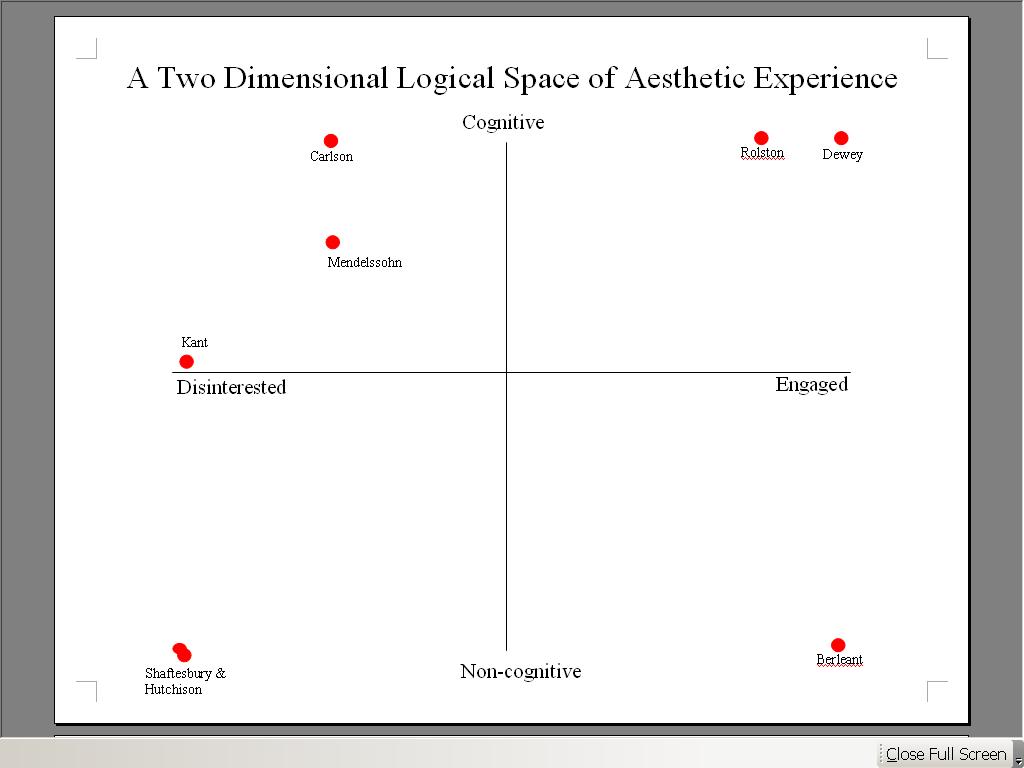
I want to assert that aesthetic disinterestedness, as it has been described in western philosophy since the 18th century, and nonattachment, as it has been has been described in Indian and Buddhist philosophy for thousands of years, name similar mental states. Here's the problem: in talking about aesthetic experience of nature in the western tradition, I distinguished two axes of disagreement. People have argued over whether aesthetic experience is "disinterested" or "engaged" and whether it is "cognitive" or "noncognitive." The cognitive/noncognitive dispute is over whether the aesthetic appreciation of a natural environment, should be guided by ideas from history and natural science or whether it should be free of all guiding narratives. The disinterested/engaged debate is over whether one should feel a personal stake in the object of aesthetic contemplation or view it from a detached perspective. You can then map the position in the debate over the aesthetics of nature onto a two-dimensional space, like this.

A two dimensional logical space of aesthetic experience

I love making little diagrams like this. I'd like to populate this one with a lot of thinkers and then actually publish it with my article, but it probably wouldn't be scholarly enough.

In any case, I want to put Buddhist nonattachment in the lower left, as a disinterested, noncognitive state. This sounds right if you talk about the dots as "experiential states." But it does't work as well if you say they are "mental states", which is what I did in the last post. Noncognitive mental state doesn't sound right. I suppose I should just change "mental" to "experiential" when I work the material in the last post into the actual essay, but that might make the references to meaning in the head awkward.

Drop the problem and move forward.

We need to zoom in on the lower left corner, look at the notions of disinterestedness that have been held in the western tradition and how they relate to noncognitive experience. Then we need to do the same for nonattachment. Lets start with disinterestedness.

Shaftsbury

kids need reading to

ok, I'm writing again

I went with Caroline down to the Rock Beach, a small stretch of sand, garbage, driftwood and stones along Lake Erie near our house. We go to hunt for pretty rocks and "sea glass" (really fragments of old bottles that have been worn smooth by the water.)

Ok, back to work. The idea of nonattachment developed during the axial age of Indian philosophy, from around 800 BCE to the beginning of the common era, an age which saw the writings of the Upanishads and the Bhagavad Gita and the lives of the Buddha and Mahavira. It cannot be traced to particular thinkers interested in promoting particular ideas, the way disinterestedness can, and it was not intended as an account of a single aspect of experience, such as beauty. Instead it was an integral aspect of a program for attaining complete spiritual liberation.

Despite the radically different origins of the two ideas, I maintain that they describe similar mental states. In each case, we are looking at a suspension of means-ends rationality and some form of putting desire on "hold." Admittedly, mental states are a bitch to individuate, and clearly depend on factors that are not "in the head," including social and physical reality (cite annoying twin earth-type research here.) You cannot know what a subject is thinking about simply by looking at the the state of his brain, because the same brain state might mean something different in different social and physical contexts. This means that on one level, the mind of a Hindu Sadhu in deep meditation is obviously going to be in a very different category than the mind of a 18th century contemplating a lovely view of the countryside. Still, we can productively classify mental states based mostly on features that are "in the head", including phenomenological descriptions of the state and, as technology advances, descriptions of physical brain states, using only very general descriptions of external social and physical reality. For instance, we can say that two individuals in very different circumstances are both "fearful," based on their descriptions on how they feel and increased blood flow to, say, the amygdala,1 even though one person is afraid of karmic pollution from touching a dalit and the other a humiliating loss of face in the House of Lords. Similarly, I think that if you focus on the aspects of disinterestedness and nonattachment that are mostly "in the head", you will see a strong resemblance. More importantly, insights into the mental state as it has been described in one tradition can help us understand related states in a different tradition.


___________

1 Whenever I read about the neurological correlates to any interesting mental process, it always seems to involve some combination of the amygdala, the hypothalamus, and the prefrontal cortex. I'm beginning to think that the brain really only has these three parts and that "increased activity in the amydala, hypothalamus, and prefrontal cortex" actually means the same thing as "brain activity." People only substitute "amygdala" for "brain" because it sounds fancy. I used to hear about the hippocampus sometimes, but I think the hypothalamus is the new hippocampus of fake brain science.

I'm writing, I'm writing

The idea of aesthetic disinterestedness was introduced in Western philosophy by Lord Shaftesbury and Francis Hutcheson. Shaftebury's ideas were developed in works he wrote between 1705 and 1710, including Sensus Communis and The Moralists most of which were folded into a summary volume of his life's work,Characteristics of Men, Manners, Opinions, Times (1714). Hutcheson's aesthetic ideas were promulgated in Inquiry concerning Beauty, Order, Harmony and Design (1725). Hutcheson was primarily interested in defending the thesis that beauty was perceived directly by a rational intuition. Shaftesbury's ideas, which came earlier, are harder to classify, but he is still basically concerned with the thesis that the experience of beauty is a perception of divine harmony and order.

The roots of nonattachment in Eastern philosophy are much more diffuse. The idea was already commonplace amongst the spiritual seekers and world-renouncers of India at the time the Buddha began to preach his version of the practice. The primary interest here was not any kind of perception, but the attainment of a mental state that would preclude the build up of Karma, and thus free one from the tyranny of samsara (rebirth). In the Gita, composed between 200 and 500 years before the common era, the nonattachment is used to reconcile the conflict between the need to act in the world and

argh. Kids need attention. And it doesn't take much to get me to play outside with them on a day like today.


In the terms I outline in my paper, they understood the aesthetic experience as being disinterested and noncognitive.

Buddhist non-attachment and aesthetic disinterestedness--ok, I'm going to write this.

Ok, I have a mental block.

Two and a half years ago, I had a paper accepted to Environmental Values, with a few conditions, mostly that I clarify the relationship between two concepts I employed, Buddhist non-attachment and aesthetic disinterestedness. I estimated that this would require three to five pages of new material. When I am in a groove, I produce about a page of academic prose a day. I should have been able to send this back right away, but I didn't. Whenever I got time away from day to day responsibilities--teaching, parenting, the job market--I spent it on lower prestige projects. (Or in the case of the Buffy paper, negative prestige projects.)

I'm on spring break now. I have no pressing responsibilities until next Sunday. I'm behind on grading, sure, but sometimes other things have to take priority. The upstairs sink is clogged, but we can always brush our teeth in the downstairs sink. The weather is almost spring like, for once, but Molly can take the kids outside--she just got done with one of her big projects.

So I can do this. I can do this. I can do this. Or maybe I'll continuously blog my mental block for five days.

Wednesday, February 18, 2009

People are talking about the book I am in!

The website Watchmencomicmovie has put up a thread to discuss Watchmen and Philosophy, a book that I have an essay in. In the thread, people are asked to pose questions which will be put to the book's editor, Mark White, in an upcoming interview. One of the first questions to come up, from EmPiiRe x, is actually about the topic of my essay, deontology and utilitarianism. Annoyingly, EmPiiRe x suggests that we made a mistake I went out of my way to avoid: treating Veidt as a straightforward utilitarian, rather than a megalomaniac who uses utilitarianism to rationalize his actions. I've posted a response you can check out at the end of the thread.

The amount of attention the book is getting is a pleasant surprise. Molly and I went into Borders last weekend and there was a whole display dedicated to Watchmen, including two piles of copies of Watchmen and Philosophy. I've never been in a book that gets displayed like that.

Also interesting this thought on livejournal about the contradiction between Dr. Manhattan's own existence and his professed materialism. (The blogger also mentions the book I'm in!)

Saturday, January 17, 2009

Updated CV and publication links

I've got some new projects--after like four years I heard back from Slayage about my Buffy paper, my review of Cylons in America should be posted soon, and I'm sending my CV to someone organizing a academic journal on philosophy and pop culture. So its about time I get some of my online professional stuff in order.

Here is the curriculum of my professional life (click to see whole thing):


Articles

Article title links to article, book or journal title links to book or journal

  1. “The Theragāthā Model of the Aesthetic Appreciation of Natural Environments” accepted, subject to revision, at Environmental Values. 

  2. “Moral Complexity in the Buffyverse” accepted, subject to revision, at Slayage: An International Online Journal of Buffy Studies.

  3. “Means, Ends, and the Critique of Pure Superheroes” in Watchmen and Philosophy ed. by M. White, (Oxford: Blackwell Press, 2009)

  4. “‘What a Strange Little Man’: Baltar the Tyrant?” in Battlestar Galactica and Philosophy ed. by J. Eberl (Oxford: Blackwell Press, 2008)

  5. “The Other Value in the Debate over Genetically Modified Organisms” In Ethical Issues in the Life Sciences, edited by F. Adams. (Charlottesville, VA: Philosophy Documentation Center, 2007).

  6. “Germ-Line Enhancement of Humans and Nonhumans” Kennedy Institute of Ethics Journal Special Issue on Justice and Genetic Enhancement 15:1 (March 2005).

  7. “Three Problems for the Aesthetic Foundations of Environmental Ethics,” Philosophy and the Contemporary World 10:2 (Fall–Winter 2003).
Reviews for Metapsychology Online. http://mentalhelp.net/books

I review books a lot of places, but these are easily accessed online.
  1. C.W. Marshall and Tiffany Potter (eds.) Cylons in America: Critical Studies in Battlestar Galactica, Jan 15, 2009.
  2. William Irwin and Jorge Gracia (eds.) Philosophy and the Interpretation of Pop Culture, Mar 25th 2008
  3. Maxwell J. Mehlman, Wondergenes: Genetic Enhancement and the Future of Society, July 25, 2006.
  4. Peter Coates Nature: Western Attitudes Since Ancient Times Janurary 9, 2006
  5. Elisabeth A. Lloyd, The Case of the Female Orgasm, August 2, 2005.
  6. Robert Plomin et al. (eds.), Behavioral Genetics in the Postgenomic Era, March 26, 2004.
  7. Gordon Graham, Genes: A Philosophical Inquiry, June 23, 2003.
  8. Marc Bekoff, Minding Animals: Awareness, Emotions, and Heart, February 7, 2003.
  9. Susan Lufkin Krantz, Refuting Peter Singer’s Ethical Theory: The Importance of Human Dignity, July 15, 2002.

Monday, June 16, 2008

Frackity.

I submitted my draft of the Watchmen paper and felt a huge relief. The paper was good: it hit all the points I wanted to hit and was fun to read. I knew it was a little long but...the editor took one look at the file was promptly told to cut it by 25%. He also noted that I probably couldn't cut that much just by tightening the prose. I would need to lose a section. My first thought: "not the section on authoritarianism!" I am certain one reason I have never succeeded as a writer is that I haven't learned basic lessons about cutting one's own work. I get emotionally invested even in little throw away pieces like this. Damn. Well, for posterity's sake, here is the original, long version.


Means, Ends, and the Critique of Pure Superheroes
J. Robert Loftis

So Rorschach and Nite Owl meet Ozymandias in his Antarctic fortress, and Ozymandias starts explaining his insane plan, which will kill millions but perhaps save the world. While the smartest man in the world is offering up the last crucial bit of plot exposition, Rorschach looks for a weapon. He can only find a fork, but he tries to stab Veidt with it anyway. Ozymandias blocks the blow and sends Rorschach to the floor, all the while continuing his monologue. After he gets up, Rorschach tries to make another move on Ozymandias, but is blocked by Bubastis, the genetically engineered super-cat. Ozymandias doesn’t even need to turn to face Rorschach, let alone miss a beat of his exposition. Not sure what else to do, Rorschach tries talking: “Veidt, get rid of the cat.” “No I don’t think so,” Ozymandias replies magnanimously, “After all her presence saves you the humiliation of another beating” (Ch. 12 p.9). For Ozymandias, on the other hand, talking isn’t a last resort. It’s generally one of the first things he tries, and something he is always open to. He’s good at it, too. He gives extended orations, while Rorschach seems to have lost his ability to use definite articles or start sentences with a subject. And when Veidt is finally confronted by someone more powerful than he—Dr. Manhattan, the comic’s only true superhero—Veidt keeps talking and quickly turns to the one option Rorschach would never consider: compromise. If the others stay silent, they can enjoy the benefit of Veidt’s new world. Everyone takes it—after all, they can’t undo the attack on New York—except Rorschach, even though it means his certain death.

The last fight between Ozymandias and Rorschach gives a little bit of humor to an otherwise terrifying revelation. It also highlights how much the characters are foils for each other, not just in their politics and personalities, but their underlying ethical worldviews. The cosmopolitan, liberal Ozymandias is what philosophers call a consequentialist: he believes that all actions should be judged by their consequences, so that the ends will sometimes justify the means. This is a feature of his personality that is separate from his political stances, his vast worldly experience, and his overwhelming ego. He is the kind of guy who, when he has to make a decision carefully, lists the pros and cons and goes with the option that has the most pros on balance, even if it defies basic humanity and common sense. Thus we get the bizarre, murderous scheme revealed in the Antarctic fight.

Rorschach, on the other hand, isn’t just a right-wing loon. He is what philosophers call a deontologist. Rorschach’s deontology is separate from his politics, his misogyny, and his sexual hang-ups. It is even separate from his fixation on revenge as the most important sort of “right thing to do.” The deontologist says that we should not think of morality in terms of ends and means at all; instead we should only act in ways that express moral rules. Thus we see him stabbing away at Veidt, using anything he can find, even though he knows he can’t succeed. The outcome doesn’t matter; what matters is doing the right thing. Further, the fact that some things are “the right thing to do” is completely unrelated to whether those things actually help anyone. Thus, later we see Rorschach trying to reveal Veidt’s secret, not only knowing he can’t succeed, but knowing if he did succeed, it would only make the world worse, by destroying the good Ozymandias did without undoing the harm.

Watchmen is an intensely philosophical comic. Big ideas like consequentialism and deontology were clearly on Moore’s and Gibbons’s minds as they made this. I hope to show that the attitude toward both consequentialism and deontology is profoundly negative. But these are really only stepping stones to the real point of the comic. The ultimate target of the comic’s critique is authoritarianism: the idea that anyone should set themselves up as a guardian of society, an idea captured by the image of the superhero. The critiques of consequentialism and deontology, and indeed of liberalism and conservatism, support this antiauthoritarianism, which is a more central theme throughout Moore’s work, if not Gibbons’s.

This chapter will highlight the critiques of consequentialism and deontology in the comic, focusing on the parallels to the classical philosophical arguments from people like Mill and Kant. The main focus of the chapter, however, will be seeing these themes as steps toward the broader critique of authoritarianism in this book and in other works by Alan Moore.

“‘In the end’? Nothing ends, Adrian, nothing ever ends.”

When Ozymandias is being chased by Dr. Manhattan, he lures Manhattan into an intrinsic field gizmo (like the one that first created the big blue man to begin with) and activates it, seeming to zap Manhattan into vapor, and disintegrating his beloved cat Bubastis in the process. Afterward, he says offhandedly “Hm, you know, I wasn’t really sure that would work.” (Actually, it didn’t.) (ch.12, p.14) This is a great Veidt moment in a couple ways. First, it demonstrates, again, his willingness to sacrifice things he values for higher ends, second it shows his willingness to gamble on probabilities. He doesn’t deal with a world of black and white, of evil and good, like Rorschach. Everything is gray, but some gray areas are darker than others. To do the right thing, Ozymandias simply looks for the lightest shade of gray, and chooses it.

In the history of philosophy, this sort of weighing, calculating consequentialism is most associated with the doctrine of utilitarianism. Although the basic idea behind utilitarianism has been around forever, the doctrine didn’t really begin to flourish until the work of the English philosophers Jeremy Bentham (1748–1832) and John Stuart Mill (1806–1873). The core idea is simple: “actions are right in proportion as they tend to promote happiness, wrong as they tend to produce the reverse of happiness.” Utilitarianism begins with consequentialism: actions are judged by the amount of good consequences they produce. It adds to this two other important ideas. The first is a kind of hedonism: the good that one is trying to maximize in the world is happiness. The utilitarian is not worried, like Rorschach, about being sure that every criminal is punished. In fact, punishment is bad in a way, because it makes the punished person unhappy. It only becomes good if a larger good comes from it, like deterring future crime. This larger good, too, must be something that makes people happy. Simply seeing that justice is done is not a good enough consequence for the utilitarian. There must be some people out there who are happier now than they would have been if a crime had been committed against them. The other important feature utilitarianism adds to consequentialism is a belief in equality. Everybody’s happiness is weighed equally. Thus, if an action will make five people happy, and one person unhappy, you should do it, even if the one unhappy person is your mom. Or your favorite genetically engineered cat.

Ozymandias might be a full-blown utilitarian, and not just a consequentialist. An emphasis on equality can be seen in his self-help program. Anyone can be a superhero if they believe in themselves, study, and discipline the mind and the body. “There’s a notion I’d like to see buried: the ordinary person,” Veidt tells Nova Express, “Ridiculous, there is no ordinary person” (ch. 11, supp.). Veidt’s philosophy of self-actualization may not seem compatible with the hedonistic part of utilitarianism, but it actually fits quite well with Mill’s more sophisticated understanding of the doctrine. Mill very famously differed from Bentham because he thought that some pleasures were better than others. Thus the goal of utilitarianism wasn’t just to maximize pleasure for all, but to maximize the higher pleasures. One thing that is less often appreciated is that for Mill the higher pleasures come from self-development and self-growth. It is the capacity for self-improvement that largely distinguishes us from the animals, and the joy of self-improvement that largely distinguishes higher from lower pleasures. “He who lets the world, or his own portion of it, choose his plan of life for him, has no need of any other faculty than the ape-like one of imitation. He who chooses his plan for himself, employs all his faculties. ...Among the works of man, which human life is rightly employed in perfecting and beautifying, the first in importance surely is man himself.”

Utilitarianism has had many critics, and it looks like Moore and Gibbons are among those critics. We can see this first of all in the structure of the story. According to comic book formula, Rorschach is the hero of the story and Ozymandias is the villain. Rorschach is the first person we see, and the plot is structured around his investigation of some killings. The audience uncovers the truth behind the killings as Rorschach does. Ozymandias, on the other hand, is the one who is revealed to be behind the killings, and when he is found out, he reveals his elaborate plot involving the death of millions and a plan to take over the world.

A lot of the comic falls into place if you see Rorschach as the hero and Ozymandias as the villain. The book is about the corruption of the self-appointed guardians of society. Utilitarianism can be seen as the doctrine that enables that corruption. Once one starts in sacrificing one thing for another, it gets easy to make the sacrifices that will serve one’s own interest. Ozymandias obviously falls into this trap. He may say that the purpose of his plan is to “usher in an age of illumination so dazzling that humanity will reject the darkness in its heart” (Chapter XII, page 17). But we know the first thing he thinks about when he sees his crazy scheme succeed was his own glory: “I did it!” he shouts, fists in the air. And he immediately begins planning his own grand role in this utopia.

If Ozymandias is the villain, utilitarianism brought him to that point by allowing him to rationalize his self-serving ends. It also brought him to villainy by giving him a way to ignore the monstrosity of his own acts. One very effective way, rhetorically, to argue that the ends can never justify the means is to simply emphasize the horrific nature of some sacrifices. Moore and Gibbons do this well. For 11 issues of the comic we have been peering into the lives of some ordinary New Yorkers around Bernard’s newsstand. We’ve grown to like them and sympathize with them. Then at the beginning of chapter 12, we get six full page panels of carnage, and among the bodies we can make out all the characters we have been following for the last 11 issues. It’s devastating, especially with Gibbon’s lurid use of greens and yellows.

While these moments make for powerful points in the comic, they do not do very well as philosophical objections to utilitarianism. They have come up, but they don’t get very far. Mill was at pains to emphasize that utilitarianism is the very opposite of a theory that would let you rationalize doing what is in your own interest: “I must again repeat, what the assailants of utilitarianism seldom have the justice to acknowledge, that the happiness which forms the utilitarian standard of what is right in conduct, is not the agent’s own happiness, but that of all concerned.” Now Mill is well aware that one cannot in advance know which things will really maximize happiness for all. We cannot predict the future, and are easily tempted by all sorts of things. To this end, Mill recommended that we do not simply try to calculate the best possible outcome each time we make a decision. Instead we should rely on the rules and instincts that the human race has developed over time for acting morally. Since Mill’s time the idea that utilitarianism should focus on rules has developed into the doctrine of rule utilitarianism, which says that one should live by the rules that would maximize happiness for everyone if they were followed consistently. Thus Veidt might adopt a rule for himself like “never kill,” not because killing never brings more happiness than unhappiness, but because a person who lives by such a rule would bring more happiness than unhappiness. Certainly Veidt would have never done what he did if he adopted such a rule.

A lot of the time, though, Mill seems less interested in rule utilitarianism and more interested in what gets called virtue utilitarianism: develop for yourself the personal characteristics that are likely to maximize happiness for all if you really made them a part of you. To this end, programs of self-development must instill in people the habit of associating their own happiness with the happiness of others. “Education and opinion...should so use that power as to establish in the mind of every individual an indissoluble association between his own happiness and the good of the whole; especially between his own happiness and the practice of such modes of conduct, negative and positive, as regard for the universal happiness prescribes.” Interestingly, Veidt’s self-help program does seem to do this: “When you are strong and healthy in the mind and body, you will want to react in a healthy way to the world around you, changing it for the better if you are able” (ch. 10, supp)

Thus, if Veidt’s ego has corrupted him, utilitarianism is not to blame. It does everything in its power to prevent such an occurrence. If Veidt’s education program had done what it was supposed to, if Veidt had adopted better rules for himself, none of this would have happened. Any moral system can go awry if used improperly, or, as Mill puts it, “There is no difficulty in proving any ethical standard whatever to work ill, if we suppose universal idiocy to be conjoined with it.”

But what about the sheer horror of what Veidt has done? Surely no system that would accept, let alone mandate, such behavior is truly moral. The idea that it is wrong to force people to sacrifice their well-being for the greater good is generally considered to be a part of justice. For philosophers, justice is typically thought to be a matter of fairness. Is it fair that the citizens of New York are forced to sacrifice their lives and sanity to end the Cold War, when no one else is asked to make such a sacrifice? The means for preventing this kind of unfairness is typically the doctrine of human rights. Rights tell us that there are some things the individual cannot be asked to do against her will, even if it is for the greater good. Mill basically accounts for justice and rights using the tools of rule utilitarianism. A society needs to recognize rights, because a society that recognizes rights is more likely to maximize happiness than one that doesn’t. In fact, Mill was a staunch defender of personal liberty, arguing for his famous harm principle: that the only time one can coercively intervene in another person’s life is to prevent that person from harming others. If Veidt had taken the harm principle to heart, he would never have followed through on his scheme, since he was coercively ending the lives of millions of New Yorkers who were not trying to harm anyone else. Again, the fact that he didn’t do this is no fault of utilitarianism. Any moral system will yield bad results when conjoined to an egotistical madman with near superhuman powers.

The most trenchant critique of consequentialism in Watchmen does not come from Rorschach or from the effects of Veidt’s scheme. It comes from the perspective and explicit statements of Dr. Manhattan. In one of the most moving sequences in the book, Veidt asks Manhattan, with unexpected plaintiveness and insecurity, if he’s really the good guy he thinks he is: “Jon, before you leave...I did the right thing, didn’t I? It all worked out in the end.” In the next panel we see Dr. Manhattan from Veidt’s point of view. The blue man, standing inside a model of the solar system, arms down, palms out, smiles and says “‘In the end?’ Nothing ends, Adrian, nothing ever ends.” Then he leaves the Earth for good. Dr. Manhattan’s warning is borne out four pages later, when we see Seymour, the inept assistant at the New Frontiersman, reaching toward Rorschach’s journal looking for something to fill up space in the next issue. If he grabs it, Veidt’s scheme could be ruined, and all that suffering would be for nothing.

This is a deep objection to consequentialist theories. We are asked to look to the future and calculate, to sum up the consequences of our actions, but the future is infinite, and you can’t crunch the numbers when every one of them turns to infinity. Perhaps in five years something will happen that undoes the good that Veidt did. Then, ten years after that, something good will happen that only could have happened given Veidt’s actions. Then something bad, and so on. The problem here isn’t just that we can’t know the future, but that there is too much of it. Even if we had an infinite mind to encompass the infinite future, what would we see? An infinity of happiness and an infinity of suffering? We can’t do anything to change a ratio of infinity to infinity.

And even if we could, what of it? Utilitarianism gets its motivation from the basic instinct that pain is bad and pleasure is good. Individually, you and I seek pleasure and avoid pain. Utilitarianism tries to remove the selfishness of this by asking us to seek pleasure for everyone. In doing so, it tries to make ethics a little more objective: less about what you want and more about what is good in itself. But if we keep going with this impulse to objectivity, everything loses its meaning. What does it matter if there is more pain or more pleasure in the world? We are now in the perspective of Jon Osterman after his accident: if you take too abstract a perspective, nothing seems valuable at all. The reader doesn’t know if the Shelley poem “Ozymandias” exists in the world of Watchmen, or only as the epitaph to one of its chapters. Either way he has missed its message that all achievements fade over time.

This is a defect in Ozymandias’s worldview. Unlike other characters—Rorschach, or The Comedian—he has never really confronted the question of the meaning of life, or the possibility that life is meaningless. Walter Kovacks, staring “though smoke heavy with human fat” decided that “existence was random” but chose to project on that randomness a meaning, which allowed him to become Rorschach. The Comedian, too, had this kind of moment, and all the other characters assert that it led him to a brutal nihilism. Ozymandias didn’t have an existential moment like this. All of his personal revelations are about the source of suffering in the world, not the possibility of morality. He learns that evil is not just a matter of crime, but comes from geopolitical forces. But he never questions the nature of evil and good itself. He takes a bigger view, but never the biggest view.


“Evil must be punished. Even in the face of Armageddon I shall not compromise in this”

So Ozymandias is the villain, a tragic figure, whose flaw was to think the end can sometimes justify the means, a mistake brought on by his overwhelming ego and failure to appreciate the tragic nature of life. And that means Rorschach is the hero, right? Well, no. Rorschach is a foil for Veidt in every respect: the unkempt, taciturn, right-wing outsider against the slick, eloquent, liberal celebrity. Most importantly for us, Rorschach is the deontologist to Veidt’s consequentialist. But just being a mirror to the villain doesn’t make you the hero.

Rorschach is a deontologist. We see this in his constant mantra “In the face of Armageddon I shall not compromise” (Ch.1, p. 24, ch.12 p.20, etc) The mantra is an echo of the deontologists’ slogan: “Fiat justitia ruat coelum”: “Let justice be done, though heaven should fall.” Deontology goes beyond saying that the ends never justify the means. It actually says you shouldn’t think in terms of ends and means at all. Once you start thinking about means and ends, you’ve actually left the realm of morality altogether. You are only thinking about how to get something you want, either for yourself or someone else. The most famous deontologist in Western philosophy was Immanuel Kant (1724–1804). For Kant, morality begins with the good will. Anything else you might value in life—intelligence, strength, even happiness itself—can be used for evil. Think about the sicko Rorschach confronts in the chapter “Symmetries,” the one who butchered the girl and fed her to her dogs. (You don’t have to think about it too hard.) He took pleasure in what he did, but is his happiness good? Can’t be. Even happiness can be evil. So the only thing good, really, is the will to do good, the mental act that says “I am going to do the right thing.”

The importance of the good will is enough to establish deontology for Kant. If you are doing something for an end, you are not doing it because it is the right thing to do. This applies both to ends that we think of as moral and those we think of as immoral or selfish. Think about another cruel and selfish act (Watchmen is full of them), like The Comedian shooting his pregnant Vietnamese girlfriend at the end of the war. A consequentialist would think this is wrong because of harm to the woman: the pain of betrayal, the life cut short. For Kant, the wrong comes with The Comedian’s motivation. He is not trying to do what is right, he is merely trying to accomplish an end that is convenient for him, getting rid of a person as if she were extra baggage. But this impure will can be present for altruistic actions as well as selfish ones. Think about the redemptive moment at Bernard’s newsstand when so many passersby intervene to break up the fight between Joey and her girlfriend Aline. If one of them were jumping in for the sake of helping Aline, that would be acting for an end, and would really be no different than acting for the sake of helping yourself. Interestingly, the people who intervene do not explain what they are doing by appealing to pity for Aline. They all give more deontological explanations: “I’m still me,” “it’s all that means anything.” (ch 11, pp.20, 23) The people who jump in are saying that given who they are, as moral people, and what the world is, a dark place that can be lit only by the good will, they have to act. They are doing the right thing because it is the right thing. Kant would be proud.

For all this, Rorschach is not the hero, and deontology is not the hero’s ideology. I wish I could show this simply by pointing out that Rorschach is a psychotic killer. For some people, being a psycho-killer might be enough to rule someone out as a hero, but in comics, as in Hollywood, crazy vigilantes have a certain cachet. Watchmen came out at about the same time as Frank Miller’s hugely successful Batman: The Dark Knight Returns, which depicted the superhero’s obsession with violent revenge as the only human response to a decaying, decadent, crime-riddled society, in need of what Billy Bragg called “a strong dose of law and order, and a touch of the short, sharp, shock.” The fascist overtones and the parallels to Rorschach’s worldview are unmistakable: a society in decline can only be redeemed by violence and exaggerated masculinity. Not surprisingly, Rorschach had a lot of fans when the book came out and still does today.

Still, there is something dangerously naive about these fans. Rorschach is a hypocrite and his ideology is far from Alan Moore’s, if not Dave Gibbons’s. Despite his “never compromise” mantra, Rorschach easily makes exceptions, for himself and for powerful people he admires. Although he delivered the announcement that he would retire under the Keane Act on the body of a dead serial rapist, he repeatedly confesses to admiring another serial rapist, The Comedian, even apologizing for The Comedian’s lapses (Ch.6, p.15). After trashing Moloch’s apartment, he says “sorry about the mess, can’t make an omelet without breaking a few eggs,” a classic bit of consequentialist reasoning (ch. 5, p. 6). He also professes admiration for President Truman, both as an adult (ch. 1, p. 1), and as an adolescent at the Charlton Home for Problem Children. As a boy, at least, he professed to admiring Truman precisely because Truman was willing to sacrifice the lives of millions in Hiroshima and Nagasaki in order to avoid even bigger losses in the war—basically the same trade-off Ozymandias makes (ch. 6 p. 31). Significantly, in all these cases, Rorschach lapses into consequentialist reasoning so that someone can play the tough guy, the strong father figure he never had. For Rorschach, commitment to deontology takes a back seat to the need to project strength in the face of moral decline. In general, Rorschach’s simplified vision of justice—with two categories, right and wrong, and one penalty, death—makes hypocrisy inevitable. If you tried to follow that code to the letter, you would have to kill everyone. If you rule out compromise, the only alternative is hypocrisy.

There is also no escaping the fact that Rorschach overtly embodies the far right politics that Alan Moore, at least publically, disdains. Rorschach was based on the Charlton Comics character The Question, who was used by Charlton artist Steve Ditko as a mouthpiece for right-wing diatribes, particularly ideas stemming from the objectivist philosophy of Ayn Rand. This all comes out for Rorschach right on the first page of the book, where we see him ranting in his journal against liberals, communists, and the decline of society (ch. 1, p. 1). There is also another parallel to Frank Miller’s version of Batman here, since Miller is a professed fan of objectivism. Moore, on the other hand, has described objectivism as “laughable,” and his own politics as “180° away from Steve Ditko’s” There’s simply no way we can call Rorschach the hero of the book.

Rorschach’s hypocrisy and his roots in objectivism are enough to show that he is not the hero. But they don’t count as objections to deontology. Just as Veidt’s personal failings didn’t besmirch utilitarianism, Rorschach’s failings don’t besmirch deontology. Any moral system is going to look bad when attached to a misogynist psychopath. Nevertheless, there is a deep critique of deontology embedded in the comic. You can see this in little moments, like when Rorschach spares his landlady, even though by his deranged moral code, he is supposed to kill her (ch. 10 p. 6). This is a moment of growth for him, but it is entirely motivated by compassion, and not the Kantian will to do the right thing. He sees that the landlady has done something his own mother never did, she has tried to spare her children the knowledge that she is a prostitute. He feels for her, and for her sake, he abandons the right thing. I take it the reader is meant to see this both as admirable and as a violation of Rorschach’s moral code, thus giving us a bit of a counterexample to deontology.

The book has more to say against deontology than this one counterexample, though. To see the real critique, we have to go back to that final moment, where Rorschach refuses to make a deal with Ozymandias. In this case, Rorschach’s deontology is not just futile, it is counterproductive. If he succeeded in breaking Veidt’s secret, he could restart the Cold War, bringing with it the possibility of nuclear apocalypse. It is one thing to say “let justice be done, though heaven may fall” and another to actually cause heaven to fall by doing justice. The latter simply can’t be the right thing to do. This is a powerful counterexample to deontology. If you have an ethic that genuinely ignores all consequences, it would be possible for an action to both be ethically mandatory, and bring about the end of the world. What kind of ethic is that?

“Who watches the watchmen?”

Neither consequentialism nor deontology—or for that matter political liberalism and conservatism—come off well in Watchmen. But critiquing these ideas is not the leading item on the agenda of Moore and Gibbons. Their deepest concern is obviously expressed in the aphorism “Who watches the watchmen?” which gives the comic its name and appears in fragmentary form throughout the book. There is a lot of heavy philosophy and important politics packed into this aphorism, though, so we need to look at it closely.

The full quotation does not appear until the very end of the book, and it does so in a weird way. Moore and Gibbons gives the original source for the line, Juvenal’s Satires, but then mentions that it is quoted as the epigraph of the Tower Commission Report. This is a detail many would pass over, if only because the work of the Tower Commission and the scandal it investigated occurred before many readers of Watchmen were even born. Perhaps this obscure bit of 80s history only appears because Moore and Gibbons were reading the newspapers, rather than Latin poetry. But the poem in which the line originally appears is about the difficulty men have keeping their women in line—a bit of patriarchy that is not a big concern for the comic. The Tower Commission, on the other hand, is exactly the sort of thing the comic is about.

The Tower Commission was established by President Reagan to investigate the Iran-Contra affair. The affair was a strange scheme in which members of the Reagan administration secretly and illegally provided arms and funding to two military groups with totalitarian impulses and appalling human rights records: the theocratic government of Iran and a guerrilla army known as the Contras, which sought to overthrow the Nicaraguan Sandinista socialist government. The scheme was complicated, and the motivations of the players were sometimes unclear, given that the groups the administration was arming were doing things that were actively opposed to U.S. interests, such as smuggling drugs and taking Americans hostage. The bottom line, though, was that administration officials were trying to circumvent our democracy by running a secret government apparatus that worked against the stated policies of the United States.

The Iran-Contra affair does not occur in the world of Watchmen. It was also an echo of another affair that does not occur in Watchmen, Watergate. Watergate, like Iran-Contra, was an elaborate scheme to circumvent democracy and centralize power in the president’s office. Indeed, the two scandals, along with the current scandal about faked intelligence leading up to the Iraq war, involve overlapping sets of players. These scandals do not happen in the world of Watchmen because Nixon gets away with Watergate in Watchmen. The book implies that The Comedian assassinated Woodward and Bernstein, the journalists who uncovered the Watergate scandal. It also hints that The Comedian, perhaps working with Nixon, assassinated Kennedy in this version of history. Secret dealings like these, combined with the superhero-aided victory in Vietnam, allow Nixon to consolidate extraordinary power, changing the constitution to allow him to serve five terms.

Moore and Gibbon’s alternate history is a warning about how a democracy can collapse into authoritarianism. This is something Moore had done before in V for Vendetta. In that comic, he imaged England sliding into fascism after limited nuclear exchanges in Africa and the European continent followed by environmental and economic collapse. In the introduction to the first DC Comics release of V, Moore laments some of the simplistic mistakes he made in that book
Naiveté can also be detected in my supposition that it would take something as melodramatic as a near-miss nuclear conflict to nudge England toward Fascism...It is 1988 now. Margaret Thatcher is entering her third term of office and talking confidently about unbroken conservative leadership well into the next century...the tabloid press are circulating the idea of concentration camps for persons with AIDS. The new riot police wear black visors, as do their horses.
Moore was not satisfied with the picture of a decline of a democracy into authoritarianism in V, and Watchmen is in part a correction of this. The reference to the Tower Commission is not accidental, nor is the depiction of the Nixon administration that emphasizes shady characters like G. Gordon Liddy and Al Haig. It
is all part of his picture of an authoritarian takeover.

The pairing of Ozymandias and Rorschach is a crucial part of this picture, and one that keeps it from being a petty rant against some contemporary political figures. We see in these characters that anyone can be corrupted. The real lesson is that no one, no matter what their political orientation, should be entrusted with too much power. Speaking in 2000 about the fascist takeover depicted in V, Moore remarked “As far I’m concerned, the two poles of politics were not Left Wing or Right Wing. In fact they’re just two ways of ordering an industrial society and we’re fast moving beyond the industrial societies of the 19th and 20th centuries. It seemed to me the two more absolute extremes were anarchy and fascism.” For Moore it really doesn’t matter if those who seek to control society are liberals like Ozymandias or reactionaries like Rorschach. They are still basically working the engines of control in an industrialized society. Further elaborations of the ruling ideology—as consequentialist or deontological, cosmopolitan or nationalist—are similarly irrelevant.

Moore calls the two real poles at work in society anarchy and fascism, and he actually describes himself as an anarchist, although he is sure to distance himself from the actions of his anarchist protagonist V. Anarchism literally means belief in living without leaders. As a political ideology it refers to any social system that doesn’t require government to function. Actually an incredibly diverse range of ideologies have gone under the name “anarchism.” In the 19th and early 20th centuries, it was largely a labor movement, which basically sought to replace the workings of government with class solidarity. In the later 20th century, a primitivist version of anarchism, with the incredibly idealistic goal of returning humankind to a hunter-gatherer system where government is unnecessary, has grown in popularity. There are even followers of Ayn Rand who call themselves anarchists, who wish to replace government with the functioning of a free market. However, Moore’s anarchism isn’t so much about utopian schemes as it is a general tendency to reject human relationships that are coercive or manipulative. Moore has commented “It’s funny with fascism or anarchy, yes, they are the two poles of politics but neither of them are actually, strictly speaking, a political system. Fascism is a kind of weird mystical system and anarchy is an attempt to move beyond the need to be politic, the need to manipulate large masses of people.”

This sort of open-ended attempt to move beyond authority is the real bottom line of Watchmen. The superheroes like Ozymandias and Rorschach represent different kinds of authority. They are people who set themselves up as different from the rest, with different costumes and different rules, for the sake of controlling others’ destiny. Moore and Gibbons want us to rid ourselves of such people.

Wednesday, May 07, 2008

hrrm

So I'm rereading The Watchmen and calling it work, because, well I can, and I've had a couple thoughts one of which made me a little dizzy.

I've been wanting to say that the real critique of consequentialism comes from Dr. Manhattan, esp with his comment to Veidt implying that the ends can't justify the means because nothing ever ends. I took this to embody at least two standard critiques of consequentialism. The first is simply the law of unintended consequences, which is illustrated well by events in the book. The second, and more interesting is the idea that since the future is infinite, outcomes in the distant future will always swamp (infinitely!) good outcomes here and now. More broadly, it is impossible to reason consequentially with an infinite time span. So you have to add some sort of discount rate, something that lowers the utility of outcomes as they recede into the future. But any discount rates are artificial and post hoc. So consequentialism doesn't work.

Re-reading the issue Watchmaker, however, I remember just how hard it is for Dr. Manhattan to embrace any moral worldview. He can only critique consequentialism to the extent that he critiques all human morality. Perhaps this fits with the general thrust of my essay, since I want to say that the book has small critiques of consequentialism and deontology which it uses to get to a critique of authority. Mostly, though, re-reading Watchmaker gives me that dizzy feeling you get when objectivity sucks away morality and feeling, the feeling Nagel writes about in The View from Nowhere. It leaves me unable to decide what to do at all, let alone write in my silly essay.

Other, less dizzying thoughts:

1. I hadn't noticed before that the history of superheroes in the fictional world of The Watchmen mirrors the history of the comic book in the real world, with a lively golden age in the 30s and 40s, a dead period in the 50s caused by public distrust of nonconformity, and a revival in the 60s.

2. What is the technical term for the kind of transition in movies and comics where a phrase or image is carried over into the next scene, acquiring new meaning?

Sunday, April 20, 2008

Critique of pure super heroes. First outline.

So my essay idea on The Watchmen was accepted. The editor said they had a lot of submissions on consequentialism and Ozymandias vs deontology and Rorschach, which doesn't surprise me in the least. They picked mine because "we thought you had the best approach (and the authoritarian angle set it apart as well)."

I need to get cracking on this. These essays books are generally cranked out on a fast time table. No doubt they will want to time the book with the release of the movie slated for March 6, 2009. (Remind me to start bitching about the movie now.) So I've put together an outline below. Mostly this is just re-arranging the elements of the proposal, and figuring out what needs to be added to make it into an essay. Notice that I've somehow managed to keep the structure of the classic five paragraph theme, just like I push on the undergraduates!

First outline
Means, ends, and the critique of pure superheroes

I. Introduction [Make this snazzier/lighter, introduce section with quote]

A. Background: The central conflict in The Watchmen is the face off between cosmopolitan liberal Ozymandias and the right-wing loon Rorschach. In addition to having easily identifiable politics, both these characters have diametrically opposed ethical viewpoints, which underlie their politics. Ozymandias, with his grand, murderous scheme to end the cold war, represents consequentialism, the belief that all action should be judged by their consequences, so that the ends will sometimes justify the means. Rorschach, with his unbending principles in the face of apocalypse, represents the contrasting idea, deontology. The deontologist says that we should not think of morality in terms of ends and means at all, and instead only act in ways that express moral rules. During the course of the comic, both these ethical viewpoints gets a searing critique. The prominence of these themes and critiques makes many people think the comic is really all about liberalism, conservatism, consequentialism and deontology. But these are really only stepping stones to the real point of the comic.

B: Thesis: The ultimate target of the comic’s critique is authoritarianism, the idea that anyone should set themselves up as a guardian of society, an idea captured by image of the superhero. The critiques of consequentialism and deontology, and indeed of liberalism and conservatism, support this anti-authoritarianism, which is a more central theme throughout Moore’s work. The comic is not a purely negative work, however. It provides a positive moral image in the person of Hollis Mason, a rather ordinary man who used to dress up in a very corny costume and, when the book opens, is running a car repair shop (“Obsolete models a specialty!”)

C: This chapter will: This essay will highlight the critiques of consequentialism and deontology in the comic, focusing on the parallels to the classical philosophical arguments from people like Mill and Kant. I will also touch on the interaction between normative ethical theories like consequentialism and deontology and political theories like liberalism and conservatism, both in history and in the lives of the characters. The main focus of the chapter, however, will be seeing these themes as steps toward the broader critique of authoritarianism in this book and in other work by Alan Moore.

II. “‘In the end’? Nothing ends, Adrian, nothing ever ends.”

A. Ozymandias a consequentialist.

B. Consequentialism and liberalism history with parallels to Ozymandias.
C. Critique of consequentialism imbedded in structure of the story. Ozy has the villains role: Rorschach is the viewpoint character, the audience learns of the nefarious plot as he does.

D. Critique of consequentialism imbedded in theme of the corruption Ozymandias. The most prominent theme of The Watchmen—the one alluded to in the title, the one most clearly signaled by the development of the characters and the history of the alternative universe the comic takes place in—is the easy corruptibility of the guardians of society. This is obviously part of Moore’s overall critique of authority. More on that latter. Right now we just need to see that consequentialism is the means by which Ozymandias is corrupted.

E. Critique of consequentialism imbedded in the perspective and explicit statements of Dr. Manhattan. Ozymandias’s worldview doesn’t just corrupt him, it is ultimately futile. This is where the connection to the Shelly poem becomes important.

F. Discussion of philosophical examples of the critiques in (D) and (E) and how consequentialists like Mill have responded to them.

III. [Quotation about how crazy Rorschach is]

A. Rorschach as deontologist. Emphasize that this portrayal is as much a critique of deontology as the portrayal of Ozymandias is a critique of consequentialism.

B. Deontology and conservatism history with parallels to Rorschach.

C. Deontology in the structure of the story: The critique of consequentialism does not come from the story’s deontologist, Rorschach, but from Dr. Manhattan.

D. Critique of deontology imbedded in the theme of corruption of Rorschach.

E. Rorschach’s deontology not just futile but counter productive, especially his potentially world ending act of sending the details of Ozymandias’s plan to the New Frontiersman magazine.

F. Discussion of philosophical examples of the critiques in (D) and (E) and how deontologists like Kant have responded to them.

IV. “Who watches the watchmen?”

A. The role of anti-authoritarianism in the comic

B. The role of anti-authoritarianism in Moore’s work in general.

C. Anti-authoritarianism & anarchism as a real political philosophy,

V. Conclusion: I said I was going to do it, and now I done did it.

Tuesday, March 25, 2008

Philosophy and the Interpretation of Popular Culture

Bill Irwin, the major force in the recent explosition of philosophy and popular culture books, has edited, along with Jorge Gracia, a book about the topic aimed primarily at scholars and academic philosophers. It's called of Philosophy and the Interpretation of Popular Culture. My review is up at Metapsychology Online.

(Do me a favor and click through, I was late with the review and I want to get back on the editor's good side by generating lots of traffic.)

Sunday, June 24, 2007

Battlestar Paper Part III

Here is the third and final part of the rough draft of my Battlestar Paper. Part 1 is here, part 2, here. This is all fairly light in terms of what is possible with philosophy and popular culture. I'll have a review out soon of this book, which will get deeper.

“Are You Alive?”: The Half-life of the Unjust as Seen in Boethius and BSG

The first line spoken in the reenvisioned BSG is “Are you alive?” The question is unsettling: it is asked by a robot (a Six) to a human being (a Colonial officer sent to meet with the Cylons at the remote Armistice Station.) Clearly if anyone is not alive here, it is the robot, right? Yet the Six is asking this question of a human, and when he, tremblingly, says, “Yes,” she says “Prove it,” and gives him a long open-mouth kiss, as two centurions look on stoically, their eyes going “wrrrrom wrrrrom,” before the whole station is annihilated in a Cylon attack. This opening scene is mirrored in the episode “You Can’t Go Home Again,” when Starbuck, marooned on a planet without oxygen, finds a Cylon raider that has crashed. Opening a hatch, she finds living tissue underneath. Realizing that the spacecraft has no pilot, but is itself a robot, Starbuck whispers with wonder, “Are you alive?”

The Cylons and the humans have difficulty recognizing each other as alive. They don’t fail to recognize each other as organisms of some kind. They each see that the other can bleed. But they don’t recognize the other as a living person. This brings out another important theme in Western philosophy, the question of what it means to be a person. This issue touches both on ethics, which as we’ve seen is the study of right and wrong, and metaphysics. Metaphysics is the study of existence, what existence is, and what sort of things can be properly said to exist. When humans and Cylons fail to recognize each other as persons, they are making an ethical decision, because they are saying they don’t have ethical duties to the other side. It is also a metaphysical decision, because they are putting limits around a category of reality. Reality contains persons, but it also contains some other things like look like persons but aren’t really, because they’re robots. (Or, if you are a Cylon, because they are not robots.)

One philosopher who took seriously the connection between ethics and metaphysics in understanding the idea of a person was the Roman philosopher and theologian Boethius. Boethius was a senator, and proud of his Greco-Roman heritage. But he was also a Christian, a monotheist who believed the world was a product of an all-loving, all-powerful, and all-knowing God. A major project for him was reconciling the wisdom of Greek philosophers like Plato with Christian teachings. Boethius also was in a position to think seriously about the nature of a tyrant. The Roman Empire had essentially collapsed and broken in half. The western half, where he lived, was ruled by a barbarian, the Ostrogoth Theodoric. Theodoric persecuted Boethius, believing him to be a traitor. At the time Boethius wrote his greatest book, The Consolations of Philosophy(3), he was under house arrest, waiting to be executed. The opening problem for that work is “how could a just God allow this to happen? Why do I suffer while a tyrant like Theodoric prospers?” Boethius’s answer looks to his Greek heritage, to Plato and his treatment of the tyrant. Boethius accepts Plato’s psychological vision, and raises it to a metaphysical level. The evil person, for Boethius, is not only enslaved, he isn’t even really human. In fact, he hardly exists at all. Thus an explanation of God’s ways to man: the tyrant does not really prosper. In fact, at the moment that Theodoric’s thugs break into Boethius’s house and club him to death, Boethius is better off than Theodoric.

Boethius begins this remarkable argument by agreeing with Plato that a villain like Baltar or Theodoric has no real power, even with they hold an office like President of the Twelve Colonies or King of the Goths and Italy. Boethius’s focus is on happiness. He argues, like Aristotle (384–322 BCE) that the goal of life for all people is to be happy. Why does Baltar sleep with every woman he can? Because he thinks it will make him happy. But happiness is also identical with goodness. Things that seem to bring you happiness, like wealth, power, fame, or pleasure, will only hurt you in the end without goodness, for all of the reasons we saw with Plato’s tyrant. Baltar’s lusts only bring him misery, because he pursues them so dishonestly. True pleasure, and thus true happiness, can only be obtained in honest relationships, the sort of friendships Plato shows the tyrant can never have. But now wait, power is the ability to get what you want. People want to be happy, and men like Baltar are simply not happy. Therefore they have no real power. Thus Boethius writes, “They fail in their quest for the supreme crown of reality, for the wretched creatures do not succeed in attaining the outcome for which alone they struggle day and night” (75).

This much is in Plato, but Boethius goes farther. The evil person isn’t even really human. The Colonial officer Armistice Station may be right to say he is alive. The Cylon raider may be alive in the way a smart horse or dog is alive. But Baltar isn’t really alive, not in the sense of being a living person and not as long as he continues his path of deception. How could this be? Human nature, according to Boethius, is to be good. We were all meant to be reunited with God. But evil men fail to realize this nature. “What follows from this,” Boethius says “is that you cannot regard as a man one who is disfigured by vices” (78).

Now here’s the weird part. Evil people in fact cease to exist altogether. Something ceases to exist if it looses its nature. Think about a Viper that gets blown apart by a Cylon missile. After the explosion, something still exists. Wreckage is flying everywhere. But the Viper doesn’t exist anymore, because no one can use it to do what a Viper does, fly around and shoot things. The Viper, in being blown apart, has lost its nature. But a person who has fallen into injustice has also lost her nature. She is no longer achieving the ends of a person, just as the wreckage of the Viper no longer serves the purpose of the viper. Thus evil people cease to exist. As Boethius says, “You could say a corpse is a dead man, but you would not call it a man pure and simple; in the same way, I grant that corrupt men are wicked, but I refuse to admit that they exist in an absolute sense” (76). And thus we have a lovely justification of God’s ways to man. In fact, God did not create a world where the unjust tyrants rule while good men suffer. Quite the opposite. He created a world where the unjust fade away while the just achieve their true nature.

I think it is pretty clear that Plato’s conception of the tyrant is present in the characterization of Baltar on BSG, but can we go farther, and say that Boethius’s radical claims are also present in the show? Well, I doubt that any of the writers have read Boethius (although they may have read Plato) or were thinking at this level of abstraction. But whatever the writers’ intent, the show winds up displaying Boethian themes. Evil in the world of BSG is not a simple dark force opposed to the noble warriors of goodness. Evil men like Baltar are clearly weak and pitiable and the nature of humanity itself is questioned. Who is alive, the humans or the Cylons? A lot of questions remain unanswered in the series, but I think we will find in the fourth and final season that humans and Cylons prove they are alive by acting justly. Remember how Six asked the Colonial officer to prove he was alive: she kissed him. If Boethius is right, it is though love that we show that we are alive. The gods lift up those who lift each other up.

_____

(3) In this essay I will use the Oxford World Classics edition of this text. P.G. Walsh, trans. 1999. Boethius: The Consolations of Philosophy. Oxford: Oxford University Press. Numbers in parentheses after quotations refer to page numbers in this edition.


Update: advice and edits are no longer needed. I've gone through it all with the editors.

Saturday, June 23, 2007

My Battlestar Paper, Part 2

Here is the second part of my paper "What a strange little man": Baltar and the Image of the Tyrant, for a volume meant to introduce total novices to philosophy through the show Battlestar Galactica. Part 1 is here.

“I Don't Have to Listen. I'm the President”: The Weakness of the Tyrant as seen in Plato and Baltar

Plato’s most famous description of the life of the tyrant comes in his book The Republic,(1) a sprawling masterpiece that is meant to answer the question “why be just?” but on the way develops sophisticated theories about the nature of knowledge, art, and existence itself. The crux of Plato’s answer to the question “Why be just” is that the soul of the unjust person is out of balance. His soul is ruled by its crudest desires, and stifles any part of itself that is capable of perceiving what is best in the world. The culmination of this argument is Plato’s description of the tyrannical man, a person whose soul is like a city governed by mad dictator. The picture he paints winds up looking a lot like Gaius Baltar. The interesting thing is that right now Plato is only talking about a man whose soul, internally, is like a tyrannized city. Plato further imagines the disaster that would ensue if a person with a tyrannized soul actually became the tyrant of a city, externalizing the injustice in his breast. The resulting picture approaches Baltar’s presidency.

If you asked an average fan why Baltar is the bad guy, they would probably say because he betrayed his people to genocidal robots (a practice most ethicists frown on.) Plato would have you look at his soul. He begins by asking us to think of the part of ourselves that comes out when we sleep, the part that makes you have dreams of doing things that appall you when you wake up and remember them. This part of us, Plato says, “doesn’t shrink from trying to have sex with a mother, as it supposes, or with anyone else at all, whether man, god or beast. It will commit any foul murder, and there is no food it refuses to eat. In short it omits no act of folly or shamelessness” (571d). When you are asleep, this part of your mind gets its way, with horrifying results. Now imagine someone who lets this part of their mind rule their waking life. (Perhaps you don’t have to imagine too hard.) When you first meet this person, you might think they are a free spirit, because they do what they want when they want, but really they are enslaved, because every other aspect of their self has been subordinated to the task of satisfying whatever desire has bubbled to the surface currently.

When Plato needs to give a name to the part of the soul that rules in the tyrannical man, he calls it lust. This is a strange move. The soul is full of desires that can get us in trouble, desires for money, fame, power, drugs, even food. Like lust, these are not bad in themselves, but are ruinous if you let them run your life. Plato probably picks on lust merely because he is not a fan of the body and its biological functions, and lust is very much a bodily sin, unlike the desire for fame, and makes a better candidate for the ruin of tyrants than the other cardinal sin of the body, gluttony.

Odd though it is, Plato’s choice of lust to be the tyrant of the soul of the tyrannical man fits Baltar to a T. Baltar’s sexual exploits are the root of most of his problems, beginning with selling out the human race to the sultry Cylon Caprica Six. For the rest of the series, he is played like a fiddle by a mysterious image of Six which only he can see. She wears preposterously revealing outfits, leans on his shoulder, whispers in his ear, and gets him to advance the Cylon agenda, chiefly though his candidacy for president. But it is not just the Sixes who keep Baltar under their spell. We know he was sleeping with at least one other woman during his first affair with Caprica Six, because in the opening miniseries we see Caprica catch them together. (Baltar does a spectacularly poor job of talking his way out of it.)

According to Plato, once the soul of the tyrannical man comes to be dominated by lust, all sorts of other vices follow, and low and behold we see these in Baltar as well. Lust is not alone in his soul: it rules over a swarm of other desires, all of which must be sated, at great cost. Thus, the man with the tyrannized soul becomes a liar and a thief to satisfy all these wants. Baltar, to appease his inner Six, lies and says that he needs a nuclear weapon to make a Cylon detection device. Later after he falls under the spell of another Six he has rescued from torture, he has the nuclear weapon smuggled to her, which she promptly uses to destroy a colonial ship, the Cloud Nine, signaling the human’s location to the Cylons. But again, it is not only lust for Six that drives Baltar to lie. He also refuses to reveal that Boomer is a Cylon, out of simple fear of what she will do if he does.
But most importantly, Plato says the man with the tyrannized soul will become a traitor. If he is an ordinary man with no one else to betray, he will betray his parents. “he’d sacrifice his long loved and irreplaceable mother for a recently acquired girlfriend he can do without…for the sake of a replaceable boyfriend in the bloom of youth, he’d strike his aged and irreplaceable father, his oldest friend” (574b). If the man with the tyrannized soul has more power, he will betray his city: “he’ll now chastise his fatherland, if he can, by bringing in new friends and making the fatherland, and his dear old motherland (as the Cretans call it) their slaves” (575d). And, we can add, if he is a scientist in charge of the interplanetary defense mainframe, he will let space robots annihilate his species.

The man with a tyrannized soul is also a coward: “what about fear? Aren’t the tyrannical city and man full of it?” (178a). Baltar lies to Boomer about the results of her Cylon test because he simply can’t face her. More importantly, every lie Baltar tells gives him a new reason for fear. He has a standing fear that Roslin will discover that he has betrayed the human race. As soon as he is president, he has to order Adama to stop the investigation into the destruction of Cloud Nine, because he knows it will lead back to him. Strikingly, Baltar’s cowardice is very much driven by his self centeredness. In the miniseries, when he realizes he has let the Cylons infiltrate the Colonial defense mainframe, his first response is to be afraid for himself: what if people find out I was involved with this? Once it is clear that the whole planet is under attack, his only thought is a trembling “How can I get out of this? How can I save my own personal hide?”

One of the saddest facts about a person with a tyrannized soul is that he never has any friends, only allies or enemies. “If he happens to need anything from other people, isn’t he willing to fawn on them and make every gesture of friendship, as if he were dealing with his own family? But once he gets what he wants, don’t they become strangers again?...someone with a tyrannical nature lives his whole life without being friends with anyone, always master to one man or a slave to another.” Baltar certainly lives this way. The only person he has a relationship with is his internal image of Six, and even she is using him, his master, really. Once president, he takes with a pair of statuesque women, but they never even speak on camera, appearing to the viewer more as concubines than partners. Felix Gaeta works as his assistant, but only because he has to. Baltar clearly has a lonely existence.
Simply put, Baltar is not empowered by his perfidy. We think that life would be easier if we could just lie to people, rather than tell them the ugly truth that they are a murderous robot, but really each lie makes our own lives worse. (Baltar should have followed the wisdom attributed to Mark Twain: “Always tell the truth, that way you don't have to remember anything.”) Baltar isn’t made happy for pursuing his desires, either. He simply spends his energy and is left wanting more. Thus Plato says “The tyrant soul also must of necessity always be poor and unsatisfiable” (578a).

But there are worse things that can happen to a man than for him simply to act badly. He can act badly and get away with it. “I do not think we have reached the extreme of wretchedness,” Plato says after describing the man with the tyrannized soul. More wretched still is “the one who is tyrannical, but doesn’t live a private life, because some misfortune provides him with the opportunity to become an actual tyrant” (578c). If the man with the tyrannized soul succeeds in remaking the world after his own inner darkness, there is nothing to hold back his misery. If there is no social order, the tyrant will be so afraid of being killed by his own slaves that he will pander to them constantly. He lives “like a woman, confined to his own house” (759c). The tyrant may have thought he was acquiring power by ascending to the top of the social heap, but once there, he finds his only option in life is to work to stay there.

Similarly, Baltar thinks he gets power when he becomes president. In “Lay Down Your Burdens, part II,” when Adama tells him he isn’t listening to the evidence of an internal threat that led to the destruction of Cloud 9, he replies “I don't have to listen. I'm the President.” And as I already mentioned, as soon as he gets into office, he surrounds himself with beautiful female advisors who don’t seem to be chosen for their political acumen. But by the next season, we find that Baltar has to listen to everyone. He must pander constantly to the Cylons and if he didn’t fear an assassination attempt from his assistant Gaeta, he should have, because Gaeta tried. And like Plato’s tyrant, Baltar can’t go out in public like a normal person, for instance to the graduation ceremonies for the New Caprica Police, for fear of being attacked. Baltar’s success is entirely illusory. Thus, as Plato says, “the real tyrant is really a slave, compelled to engage in the worst kind of fawning, slavery and pandering to the worst kind of people” (579e).

There is one aspect of Baltar that does not fit Plato’s image of the tyrant, and that his is durability, a trait noted on a couple occasions by the people in a position to know him best. The first thing Baltar’s inner Six says to him, when she initially appears to him in the Miniseries is, “You know what I love about you Gaius? You’re a survivor.” The fact that they are on a raptor shuttle fleeing the genocide is testament to the truth of her statement. In the season three episode “Torn,” Gaeta explained his take-home lesson from working as an underling for the most hated surviving human: “If there was o¬ne thing I learned about Baltar, it was his extraordinary capacity for self-preservation.” Again, events in the show back the evaluation of Baltar: Gaeta was predicting that Baltar had been plotting a path to Earth to save his own hide, and low and behold, he was.

Plato doesn’t mention the idea of the tyrant as survivor, but I think this is a point where the BSG characterization is richer than Plato’s. The philosopher Julia Annas complained in her book An Introduction to Plato’s Republic(2) that the tyrant Plato portrays in The Republic is not particularly realistic, because there is no way such a madman could stay in power very long. The fact is, though, that such people do manage to seize and hold power, Baltar’s namesake Gaius “Calligula” Caesar is a classic example. Some reports out of North Korea make Kim Jung Il fit this model. The portrayal of Baltar in BSG at least gives us some hints about how this is possible. Baltar’s fearful and self-obsessed nature means he always has an escape plan.

_____
1 Plato. c350 BCE/1997. The Republic. In Plato: The Complete Works, edited by J. Cooper and D. S. Hutchinson. Indianappolis: Hackett. Following academic convention, I will refer to all passages from The Republic by their “Stephanus number”, an odd looking combination of numbers and letters which actually refers to the original position of the passage in a complete edition of Plato published way back in 1578 by the Renaissance humanist Henri “Stephanus” Estienne.

2 Julia Annas. 1981. An Introduction to Plato’s Republic Oxford: Oxford University Press

Friday, June 22, 2007

My Battlestar Paper, Part 1

One of the things I have to do while I am here is finish the first draft my Battlestar paper. For no particular reason, I've decided to post the sections of it as I finish them. Below is the intro "teaser" section. Comments welcome. [Updated to fix typos]

What a Strange Little Man: Baltar and the Image of the Tyrant

A Tale of Two Baltars: From Chair Swiveling to Prayers and Sniveling.


Baltar spent most of the original series of Battlestar Galactica sitting in a huge chair atop a 20 foot pedestal, in an otherwise empty, circular room aboard a Cylon base star, which he commanded. He was lit primarily from below—indeed, he seems to have chosen to keep a flood light between his knees. In “Gun on Ice Planet Zero,” when his subordinate Lucifer enters, he is facing the blank back wall, and turns his chair slowly around to address them. The set is preposterous: how does he command a military operation from up there? What if someone needed to show him a map? What does he do on that perch when not addressing his henchmen? Is his day filled by pressing the fingertips of his two hands together and laughing maniacally?

Actually, questions like those are misguided. The writers of the original BSG hired the late character actor John Colicos to play a classic melodramatic villain, a type he had played with great brio before on countless TV shows like Star Trek and Mission Impossible. Melodramatic villains don’t need to make too much sense: their purpose is to thrill the audience with their image of power and freedom from petty conventional morality. (Think Ming the Merciless.) In “Gun on Ice Planet Zero,” Baltar ruthlessly runs his troops into the ground in order to convince Adama that he has more power than he actually does. This image of power and freedom can actually lead the audience to identify more with the villain than the putative hero of the story. This happens especially in slasher movies, where monsters like Freddy Krueger or the Firefly family in House of 1000 Corpses and Devil’s Rejects become the real focus of the narrative.

Now consider Gaius Baltar in the reenvisioned Battlestar Galactica episode “Final Cut.” Although he has been given the first name of the infamous roman emperor more commonly known as Caligula, this Baltar does not look like he should be issuing cruel commands from a high throne. He’s dawdling in a corridor of the Galactica hoping to be noticed by reporter D’anna Biers, who has just finished interviewing a crewperson, Anastasia “Dee” Dualla, for a special on life on Galactica. Baltar’s pride is wounded because Biers hasn’t asked to interview him, but it would be beneath him to ask for an interview, so he has to pretend to just be milling around. Meanwhile, he is being goaded and manipulated by hallucinations of Six—the hypersexual Cylon woman whom he helped to sabotage the Colonial defense computers, leading to the near total genocide of his own people. The hallucinatory Six often tries to wheedle Baltar into advancing the Cylon agenda or embracing the Cylon god. This time she wants him to do the interview with Biers, presumably because his political career is useful to the Cylons. When Biers finally approaches him, he acts like he doesn’t know her and says he has to talk to his aids to check his schedule. (As far as the audience has seen, he only has one assistant, Mr. Gaeta, a bridge officer assigned to help him by Commander Adama.) After he parts awkwardly from the scene, D’anna remarks to Dee “What a strange little man.” This Baltar is hardly likely to impress audiences with his dark power. He is still the great Judas figure, the man who betrayed the human race. But he is also cowardly, vain, easily manipulated, and a prisoner of his passions.

The change in the portrayal of Baltar—apparently initiated by actor James Callis and picked up by the writers—isn’t just a clever bit of television. It represents a deep philosophical difference in the way evil is conceived. Ethics has always been a central concern of philosophy, no matter where or when it has been practiced. Ethics is the study not of how things are, but of how they should be, typically with a focus on the right thing to do or the right kind of person to be. Western philosophy has been particularly concerned with the question “Why should I do the morally right thing?” After all, don’t nice guys finish last? The Western religions try to answer this question by holding out the promise of heavenly reward, but even then the annoying tendency of nice guys to finish last poses a problem: why would an all powerful, all knowing and all loving God allow the unjust to prosper and the good to suffer?

One of the first answers put forward by philosophers in the Western tradition is that the lives of evil people are only superficially desirable. They accrue the trappings of power, but have weak souls, pinched by misery. You may think that the bad guy is the old Baltar, an imposing figure who swivels his chair to the camera to deliver his pitiless orders, but really he is the new Baltar, a sniveling coward who would prostrate himself in prayer before a strange god just to appease the ghost of an old girlfriend. Two thinkers who pursued this tactic of reenvisioning the villain as less enviable are the ancient Greek philosopher Plato (427-347 BCE) and a Roman philosopher with a big long name, Anicius Manlius Severinus Boethius (c.480–c.524 CE), generally just known as Boethius. For Plato, this point is crucial for justification for being moral; for Boethius, the explanation of God’s ways to man. Both were particularly focused on the image of the tyrant: a powerful person who gets what he wants, and who wants a lot. Both wanted you to see that the tyrant is not someone we want to be, and in fact, the more apparent power they have, the less we should envy them.

Friday, May 18, 2007

Battlestar Paper

So I'm writing a paper for the Blackwell volume on Battlestar Galactica and philosophy (my original proposal is here) and the author guidelines really push you to keep to the style of the series. Example: "Contributors should keep to the popular culture topic. Ideally, the topic should be mentioned several times on every page. At a minimum, don’t let a page go by without mentioning the popular culture topic at least once." I am of course glad to do so, but I really want to stick to the fun aspects of the style and avoid the pandering.

So the first decision along these lines has come up. They changed my title from the ponderous "Gaius Baltar and the Image of the Tyrant in Plato and Boethius" to "Being Your Own Worst Enemy: Baltar and the Image of the Tyrant." I'm down with having a catchphrase for the supertitle, but I want a better one than "Being Your Own Worst Enemy." Any suggestions?

Update: The new title is: "What a strange little man": Baltar and the Image of the Tyrant

Wednesday, April 11, 2007

Published!

My proposal for a chapter in a book on Battlestar Galactica and Philosophy, "Gaius Baltar and the Image of the Tyrant in Plato and Boethius" has been accepted! Yipee! Now all I have to do is write it.

My (third?) career as a pop culture scholar is starting to move forward. I also signed up to review Philosophy and the Interpretation of Popular Culture for Metapsychology online. This work has been a little stalled of late. My Buffy paper, based on a talk I gave at the Slayage conference, looks like it will be under consideration that the Slayage journal indefinitely. I'm beginning to think the paper was flawed anyway. My Firefly proposal was rejected, but I think I can at least turn around and send that to the third Slayage conference.

  • I actually have a lot of irons in the fire right now. In addition to the BSG project, I have to Revise the paper on the Buddhist aesthetic experience of nature for Environmental Values.
  • Develop a paper on the potential for a indigenous Chinese environmental movement as a part of my participation in this institute. An early version of the paper has been accepted to this conference. Eventually, this should go to a big journal, although I don't know which one.
  • Finally, I have two ideas kicking around that I don't entirely know what to do with: one on appreciating nature as a process and one on the aesthetic evaluation of species.


Busy busy busy.