Michelle Goldberg at Salon lets us know that the war over Christmas is back. Once again, evangelicals are declaring that any time someone says "happy holidays" instead of "merry Christmas", every time an office holds a "holiday party" instead of a Christmas party, everytime Santa is invoked before the savior, the secularists have won another victory in their struggle to destroy Christmas.
And once again, good christian liberals are insisting that they do not want to destroy Christmas, that Christ is better honored by keeping his name away from half off sales, etc.
Last year I expressed my dismay at this rhetorical move by liberals, because it got in the way of my real goal this time of year: to destroy christmas. I honored the occasion with a list of aspects of christmas that I wanted to destroy, which included "The Little Drummer Boy", twice. I've had to retract some things from that list. Thomas snoped me with the pleasant truth that in fact suicide rates do not go up around christmas. In fact, Christmas frequently leads people to postpone suicide until January.
I stand by the Grinchy sentiment of that post, however. We must stop christmas from coming. I have already seen people dressed up as the little drummer boy. Things could get worse. I may have to watch that David Bowie/Bing Crosby video of the "Little Drummer Boy" with their damnable sweaters. Something must be done. This year, I have an ally, though. Flea has come out explicitly against Christmas. Victory will be ours.
Tuesday, November 29, 2005


Victory over Productivity!
They thought they could trick me into getting work done by cutting off power to my building, so I couldn't get to the internet, but I fooled them--I'm blogging from the Library! Ha ha ha!
Monday, November 28, 2005
Let the rejection begin!
Hey, it isn't even December yet, and I've already received my first rejection letter for a job application! Pacific University writes "Look, it's not you, it's us. We love you, but we're not in love with you. We are't ready to commit right now. (Except that we're going to hire someone else tenure track.) Don't go away mad, just go away."
Saturday, November 26, 2005
In which I embrace the common phrase, "I'm spiritual, but not religious"
We do not pray in our house, in part because I am an atheist. But atheism is neither a necessary nor a sufficient condition for abstaining from prayer, and I often find myself in public circumstances praying with groups of people. One such circumstance occurred over thanksgiving.
My wife's people (on her father's side) are Quaker, going way back. I sometimes chafe at some of their stiff, almost puritan ways, but they were protesting slavery and abstaining from war back when other religions--maybe yours--were still wondering if Indians had souls. Molly's Dad, Mike, maintains his faith is by having a silent prayer before meals.
After one such prayer over break, Caroline asked me "Why you pray?" It had taken a fair amount of shushing to get her to be quiet for a short interval, and she wanted to know what the deal was.
"I better let you field that one, Mike," I said.
Molly interrupted before I could finish, saying, "Tradition," a standard answer we give Caroline whenever she asks about odd human behavior.
"Mike, did you still want to answer," I said.
"We pray to ask the Lord for help," he said.
A little later, when we were alone, Molly asked me what I thought of the incident.
"I was surprised he went with petitionary prayer. That's never been my favorite kind."
"It is, though, something that an almost three year old could understand."
"Yeah, but do you really want to give a child a Santa Claus notion of spiritual life?"
"So how would you have answered?"
"I would have said 'I try to cultivate a reverential attitude.'"
You, the internet, may be asking "A reverential attitude toward what, Mr. Atheist Person?" to which I can only answer, “You know, stuff.”
Those who fetishize the ability of science to generate knowledge think that one’s emotional life is a random, insignificant thing. But emotions can be apt or inapt. In truth, apt feeling may be more important than true belief. So here is a minimal sense in which one should be spiritual. Calling you emotional life a spiritual life begins to grant it the kind of meaning it merits.
Update: Speaking of cultivating a reverential attitude, PZ Meyrs links to this incredible BBC video of slugs mating. PZ's right. If this doesn't make you feel a little homely and inadequate, you have no understanding of beauty.
My wife's people (on her father's side) are Quaker, going way back. I sometimes chafe at some of their stiff, almost puritan ways, but they were protesting slavery and abstaining from war back when other religions--maybe yours--were still wondering if Indians had souls. Molly's Dad, Mike, maintains his faith is by having a silent prayer before meals.
After one such prayer over break, Caroline asked me "Why you pray?" It had taken a fair amount of shushing to get her to be quiet for a short interval, and she wanted to know what the deal was.
"I better let you field that one, Mike," I said.
Molly interrupted before I could finish, saying, "Tradition," a standard answer we give Caroline whenever she asks about odd human behavior.
"Mike, did you still want to answer," I said.
"We pray to ask the Lord for help," he said.
A little later, when we were alone, Molly asked me what I thought of the incident.
"I was surprised he went with petitionary prayer. That's never been my favorite kind."
"It is, though, something that an almost three year old could understand."
"Yeah, but do you really want to give a child a Santa Claus notion of spiritual life?"
"So how would you have answered?"
"I would have said 'I try to cultivate a reverential attitude.'"
You, the internet, may be asking "A reverential attitude toward what, Mr. Atheist Person?" to which I can only answer, “You know, stuff.”
Those who fetishize the ability of science to generate knowledge think that one’s emotional life is a random, insignificant thing. But emotions can be apt or inapt. In truth, apt feeling may be more important than true belief. So here is a minimal sense in which one should be spiritual. Calling you emotional life a spiritual life begins to grant it the kind of meaning it merits.
Update: Speaking of cultivating a reverential attitude, PZ Meyrs links to this incredible BBC video of slugs mating. PZ's right. If this doesn't make you feel a little homely and inadequate, you have no understanding of beauty.



Friday, November 18, 2005
Thanksgiving Break
Blogging will be light, as the family leaves tonight on an extended car trip for thanksgiving.
[impolitic remarks deleted. Honestly, I don't know what I was worried about. Everything is going great.]
[impolitic remarks deleted. Honestly, I don't know what I was worried about. Everything is going great.]
Thursday, November 17, 2005
Linguists Gone Wild: Okay, something about language...
Following a referral link in sitemeter, I came across this lovely post on the grammar of expletives, which begins with the observation that expletives are their own grammatical category and ends with the hypothesis of an older language module, older than the modules that give us full human language, which covers simple context neutral expressions, like greetings and expletives. Really quite nice.
Wednesday, November 16, 2005
I hate computers
So we get this new wireless internet connection, and the first thing I discover is that the "wireless" part is bullshit, because the computer can only find the signal if it is sitting on the desk right next to the wireless router. The next thing I discover is that even when the computer is on the desk, just a few inches from the router, the connection is slow and is frequently lost altogether. So then I think, "Well fuck, if I can't actually move the computer, why not just plug the connection that currently runs from the wall into the router directly into the computer? I mean, why go through the router if it does nothing for me?" This immediately causes me to lose all internet connectivity altogether. Even after I put the cord back where it was originally.
So everything’s back in its original configuration, and there are no less than three (3) icons in the lower right corner telling me that I have an “excellent” wireless connection, but no web browser can find any web page. And I’m starting to say “grrrrr.” And Molly is starting to say “Um, Rob?” and I say “WHAT?!” in a tone that was not at all snappish, I swear, and Molly says “Nevermind. I am going to bed.” And I reboot a few times. Then I look at the paperwork that came from our new internet provider. It says “Premier Wireless rules and acceptable use policy agreement shall be between Premier wireless I.P. Inc, with its address at…..” I look at the help screen that comes up with one of the many wireless connection icons in the lower left. It says “make sure that you have the correct network name, encryption settings, and station ID (or MAC address)” but doesn’t clue me into what those are.
I shake my fists at the sky and curse the gods and goddesses of information.
Then I try the internet again and it works.
So everything’s back in its original configuration, and there are no less than three (3) icons in the lower right corner telling me that I have an “excellent” wireless connection, but no web browser can find any web page. And I’m starting to say “grrrrr.” And Molly is starting to say “Um, Rob?” and I say “WHAT?!” in a tone that was not at all snappish, I swear, and Molly says “Nevermind. I am going to bed.” And I reboot a few times. Then I look at the paperwork that came from our new internet provider. It says “Premier Wireless rules and acceptable use policy agreement shall be between Premier wireless I.P. Inc, with its address at…..” I look at the help screen that comes up with one of the many wireless connection icons in the lower left. It says “make sure that you have the correct network name, encryption settings, and station ID (or MAC address)” but doesn’t clue me into what those are.
I shake my fists at the sky and curse the gods and goddesses of information.
Then I try the internet again and it works.
Objectivity is a process, not a result
The NYT is reporting on a new report by the inspector general of the Corporation for Public Broadcasting (CPB) on the reign of former CPB chairman Kenneth Y. Tomlinson. While chair, Tomlinson launched a campaign to rid public broadcasting of an alleged liberal political bias. Turns out to do so he violated every law that had been set up to shield public broadcasting from political bias. He personally pushed for funding of shows, including a show by Wall Street Journal writers, even though the board of directors isn't supposed to make content decisions. He imposed political tests on hiring and promotion. He singled out some programs for scrutiny, like “Now with Bill Moyers,” because he did not like their political content. Again, this was in the name of promoting "objectivity."
If Tomlinson is genuinely concerned about objectivity, he is grievously confused about what objectivity is. You do not call a process of gathering information (like reporting on a public broadcasting station) objective because it yields the results you like. Nor do you call a process of gathering information objective because it yields results equally favorable to you and your opponent. A process of information gathering is objective if it follows procedures which are known to have lead to truth in the past. A detective investigating a murder does not only gather evidence that will point to the guy he thinks did it. Nor does he gather evidence that implicates all suspects equally. He gathers the sort of evidence that has uncovered crimes in the past.
Of course, it could be that Tomlinson was not interesting in objectivity, but in power. His actions fit the pattern revealed in another report, this one on the way the FDA mishandled the rejection of over the counter Plan B. Each time, we see procedures designed to improve objective decision making trashed in order to achieve a conservative agenda.
I am finding myself quite the proceduralist in my old age. Perhaps it seems odd. In graduate school guys like me were all about the feminist and lefty criticisms of objectivity and science. But we never tried to do in objectivity altogether and replace it with a simple power struggle. The feminist epistemologists I respected—Helen Longino for instance—were all about creating a richer understanding of objectivity, and indeed of knowledge generating procedures. Essentially the camp that emerged in the 90s understood objectivity as intersubjectivity, and attempted to develop social epistemologies that exploited this fact to create better knowledge generating procedures.
(Ok, guys like Stanly Fish and Richard Rorty were all about replacing objectivity with a power struggle. But you know what? No one in philosophy liked them. They are really Ward Churchills of epistemology.)
If Tomlinson is genuinely concerned about objectivity, he is grievously confused about what objectivity is. You do not call a process of gathering information (like reporting on a public broadcasting station) objective because it yields the results you like. Nor do you call a process of gathering information objective because it yields results equally favorable to you and your opponent. A process of information gathering is objective if it follows procedures which are known to have lead to truth in the past. A detective investigating a murder does not only gather evidence that will point to the guy he thinks did it. Nor does he gather evidence that implicates all suspects equally. He gathers the sort of evidence that has uncovered crimes in the past.
Of course, it could be that Tomlinson was not interesting in objectivity, but in power. His actions fit the pattern revealed in another report, this one on the way the FDA mishandled the rejection of over the counter Plan B. Each time, we see procedures designed to improve objective decision making trashed in order to achieve a conservative agenda.
I am finding myself quite the proceduralist in my old age. Perhaps it seems odd. In graduate school guys like me were all about the feminist and lefty criticisms of objectivity and science. But we never tried to do in objectivity altogether and replace it with a simple power struggle. The feminist epistemologists I respected—Helen Longino for instance—were all about creating a richer understanding of objectivity, and indeed of knowledge generating procedures. Essentially the camp that emerged in the 90s understood objectivity as intersubjectivity, and attempted to develop social epistemologies that exploited this fact to create better knowledge generating procedures.
(Ok, guys like Stanly Fish and Richard Rorty were all about replacing objectivity with a power struggle. But you know what? No one in philosophy liked them. They are really Ward Churchills of epistemology.)
Tuesday, November 15, 2005
Wead! Wead!
Caroline needs to learn a lot about how to ask for things nicely. This comes out often when I am reading to her. If I pause momentarily to, say, talk to my lovely wife, Caroline starts bouncing in my lap yelling "Read! Read!", except she can't pronounce her r's very well, so she really yells "Wead! Wead!"
This happens so often that I have completely internalized it. On a busy day like today, when I have a lot of research that needs to get done quickly, I hear a little voice in my head--an angry, impatient toddler--yelling "Wead! Wead!"
This happens so often that I have completely internalized it. On a busy day like today, when I have a lot of research that needs to get done quickly, I hear a little voice in my head--an angry, impatient toddler--yelling "Wead! Wead!"
Sunday, November 13, 2005
Strong Evidence of Ethics Violations by Woo Suk Hwang
Woo Suk Hwang and his team have led the world in theraputic cloning and stem cell research. They were the first to create stem cell lines from a cloned human embryo. They recently announced that they plan to create hundreds of new stem cell lines every year.
Apparantly there have also been rumors that the eggs for these cloned embryos came from one of Hwang's junior team members, which is always an ethics violation because it smacks of coersion. The team member may have also received illegal payments. Now a team from the University of Pittsburgh is pulling out of a collaboration with Hwang's team because they are convinced these accusations are true. I think it would take strong evidence of serious wrongdoing to get people to walk away from this much money.
This is the WaPo article, and this is the bioethics.net take on it. Also see the comment at bioethics.net on the Korean bioethics community, which has long distrusted Hwang.
Apparantly there have also been rumors that the eggs for these cloned embryos came from one of Hwang's junior team members, which is always an ethics violation because it smacks of coersion. The team member may have also received illegal payments. Now a team from the University of Pittsburgh is pulling out of a collaboration with Hwang's team because they are convinced these accusations are true. I think it would take strong evidence of serious wrongdoing to get people to walk away from this much money.
This is the WaPo article, and this is the bioethics.net take on it. Also see the comment at bioethics.net on the Korean bioethics community, which has long distrusted Hwang.
Saturday, November 12, 2005
Fuck *ff w/her Hat
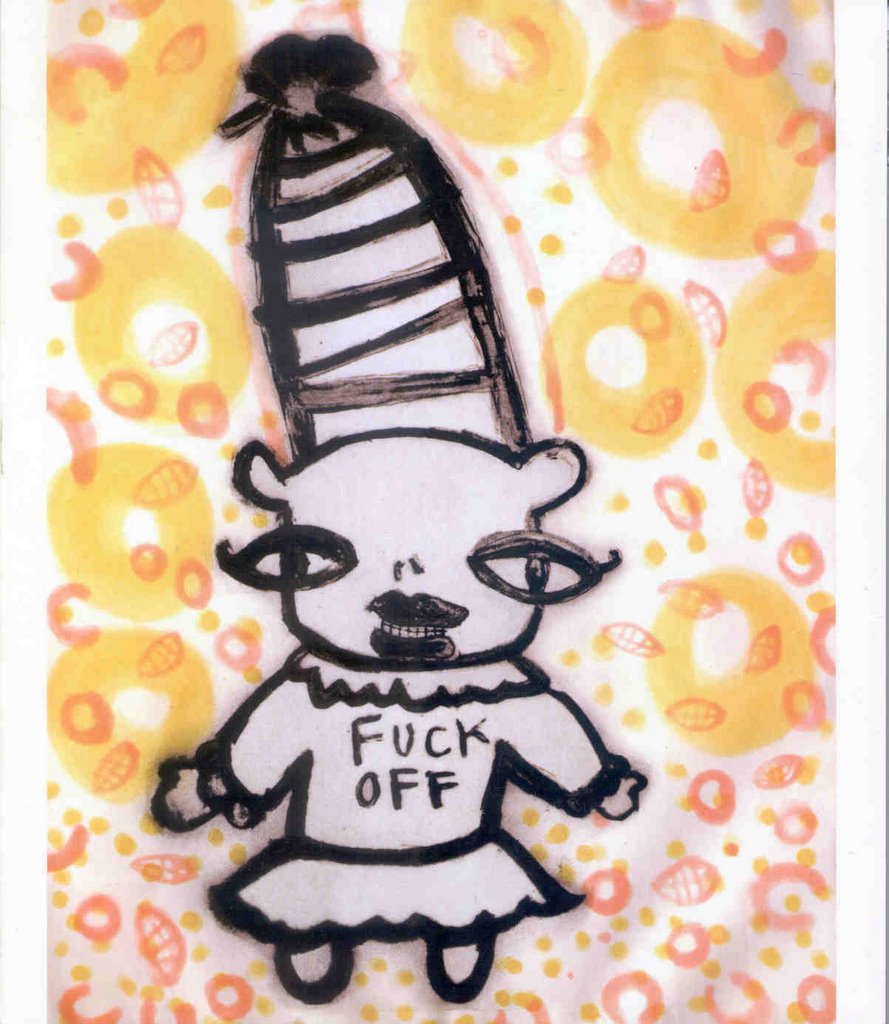 So last week I got the coolest thing I have received from campus mail at SLU. It was a flyer for this show at the Brush Art Gallery by Melanie Yazzie. The cover of the flyer was the drawing to the left, entitled "Fuck Off w/her Hat."
 This is a really nice piece (and I haven't even made it to the Gallery to see it in person yet) and not just because the "Fuck Off" gave me a chuckle when I picked up my mail. Nor was I entranced just because everything in the design of the image draws your eyes to the "Fuck off," the way that it is centered, the black writing against a bright colored background, etc. I was amused by the juxtapositions. The thick black lines of the figure against the orange and red background. The attempted cutesiness of the figure, with her large wide set eyes, and the actual crassness of the way she is drawn, with those thick black lines (again.) Also, the orange and red marks in the background look like the lip prints from the character that somehow have moved from the world of black and white to the world of color. The title is cool too. It lets you know that "Fuck off" is the name of the character. It also points you to her hat, which, as Molly pointed out to me, looks a lot like a penis. I was impressed enough with the flyer to put it on my office door. Why not, I thought, students will know that this is a work of art, and that the "fuck off" is not directed at them.
well, the day after the flyer went out, the brouhaha started on the fac/staff listserv. People were offended. How dare university money be spent on this flyer! (People seemed to know not to object to the art exhibit, so they just objected to having to look at the flyer.) Someone sarcastically suggested that we all put the flyer on our office doors, to impress visiting parents and students with our maturity. (This actually led me to take down the flyer.) Soon, though, comments got really...dumb. There was an actual "A child could have drawn this!" remark which really bugs me, because I've spent a lot of time looking at childrens’ art, and I know that no child could do that thing with the black figure on a colorful background. People's inability to distinguish child-like drawing from actual children's art mostly tells me that they don't really pay attention to what their children do when they draw. Other remarks included "what if a child saw this!?"
What was even more embarrassing about the discussion was that the best defense people could come up with for the drawing was that art is supposed to provoke. As if no one had looked at any part of the picture besides the words "Fuck Off." Then people started sending emails with the "fuck" in the title of the work starred out: "F*** Off w/her Hat" explaining that the F-word shouldn't be in public email either. I decided the asterisk looked better in the word "off."
Finally Cathy from the art gallery posted and said she was sorry. When she sent the flyers out to the public, they had a warning label that said that this was not appropriate for children. Next time, she said, I will put the warning label on the flyers that go to faculty and staff as well. No one seemed to notice that they had just been told that they were children who needed to be sheltered from dangerous content.
Ok, here's the kicker. These gallery flyers contain material that is not for the prudish all the time. The flyer for the Get Your War On show was laden with profanity. Another flyer had on the inside a comic featuring two giant anthropomorphic turds discussing the history of political cartooning.
So why did this flyer cause the controversy? I think it was exactly the stuff that made it good as a work of *visual* art: the image succeeds in focusing your attention in a way that the clip art of GYWO simply can't. No one was offended by the other images because they weren't compelling enough to look at long enough to notice the profanity. But because Yazzie has visual sense, her drawing becomes controversial.
So this gets at one of my pet theses (I keep theses as pets): the censorious people of the world really are agents of ugliness. Censors are people who are scared precisely by the things that make life interesting. And I'm not talking about words like "fuck" here (although it is dear to my heart). I'm talking about things like color contrast.
Bad body image a better predictor of diminished sex drive then menopausal status
Via Twisty comes this newspaper writeup of a study which hinted that poor body image was the primary cause of diminished sex drive in older women, and not hormonal shifts. The write up is sloppy, but the best I could glean from it is that the correlation between diminished sex drive and body image is stronger than any correlation involving hormones.
If I'm right about the study, it is exactly what Twisty says it is: another piece of evidence that patriarchal conceptions of female beauty cause a lot of misery. Still, I am also irritated at the way people are misinterpreting the science here. First, there's the Reuters Headline "Body image, not menopause, causes lack of desire." This overstates things at least two ways. First, menopause was not shown to be completely irrelevant. It was merely shown not to be as important as body image. Second, the study doesn't offer us much reason to move from correlation to causation. We don't, for instance know that being horny doesn't actually improve body image, either because people primp more, or because horny people don't have quite as many negative ideas floating around about sex in general.
I'm also irritated at this remark in the comments at twisty: "And if the shocking finding is that women don't like their bodies, then I just have to sit, mouth agape, astounded that someone actually funded this study." I am bothered, in part, because this was simply not the point of the study. I am also bothered that sociological studies can't win. If they confirm common sense, they are accused of not being worthwhile. If they go against common sense, they are accused of being the product of a demented, overanalytic scientific mind. what it really speaks to is a kind of epistemic arrogance. Nothing anyone else says could be more compelling than what I already believe.
I am, though, not so irritated that I am going to track down the original article and actually develop an informed opinion.
If I'm right about the study, it is exactly what Twisty says it is: another piece of evidence that patriarchal conceptions of female beauty cause a lot of misery. Still, I am also irritated at the way people are misinterpreting the science here. First, there's the Reuters Headline "Body image, not menopause, causes lack of desire." This overstates things at least two ways. First, menopause was not shown to be completely irrelevant. It was merely shown not to be as important as body image. Second, the study doesn't offer us much reason to move from correlation to causation. We don't, for instance know that being horny doesn't actually improve body image, either because people primp more, or because horny people don't have quite as many negative ideas floating around about sex in general.
I'm also irritated at this remark in the comments at twisty: "And if the shocking finding is that women don't like their bodies, then I just have to sit, mouth agape, astounded that someone actually funded this study." I am bothered, in part, because this was simply not the point of the study. I am also bothered that sociological studies can't win. If they confirm common sense, they are accused of not being worthwhile. If they go against common sense, they are accused of being the product of a demented, overanalytic scientific mind. what it really speaks to is a kind of epistemic arrogance. Nothing anyone else says could be more compelling than what I already believe.
I am, though, not so irritated that I am going to track down the original article and actually develop an informed opinion.
Friday, November 11, 2005
Teaching Portfolio 3.3
As a part of my big job search, I've made a .pdf version of my teaching portfolio. In case any prospective employers come by this site, the link is now to the right under "My work persona". It contains syllabi, samples of class exercises and handouts, examples of feedback on student writing, and summaries of my teaching evaluations for Spring 2005. The longer version also contains complete copies of the original evaluations. There is also a shorter version available.
Subscribe to:
Comments (Atom)
