Wednesday, March 18, 2009
Another cite for the claim that it is difficult to compare mental states across vast differences in circumstance and culture
This doesn't look like it speaks directly to the worry I want to dismiss in a paragraph, but it might be a more up to date citation to give for "meaning isn't in the head" concerns than the twin earth stuff.


from the Miscellany section of Characteristics
Were we in a disinterested view, or with somewhat less selflessness than ordinary, to consider the economies, parts, interests, conditions and terms of life which nature has distributed and assigned to the several species of creatures around us, we should not be apt to think ourselves so hardly dealt with. But whether our lot in this respect be just or equal is not the question with us at present. 'Tis enough that we know "there is certainly an assignment and distribution: that each economy or part is so distributed is in itself uniform, fixed and invariable, and that if anything in the creature be accidentally impaired; if anything in the inward form, the disposition, temper or affections be contrary or unsuitable to the economy or part, the creature is wretched and unnatural.
Judging by google search, the word 'disinterested' doesn't seem to come up in aesthetic contexts in characteristics. Also, Shaftesbury seems far more concerned with theodicy than aesthetics.
Comparing Shaftesbury to the Buddhist nature poems I consider in my essay is interesting. Both works assert that by taking up a selfless frame of mind in the presence of nature, one can attain sacred knowledge. But how they conceive the knowledge is very different, because of the different attitudes toward suffering in the two religions. Shaftesbury sees suffering as part of a just larger order, and links it to punishment of those who do not contribute to the order. The Buddhist view cuts suffering off at the root, so that the selfless person simply ceases to experience suffering.
lets try this quote.
New forms arise, and when the old dissolve, the matter whence they were composed is not left useless, but wrought with equal management and art, even in corruption, Nature's seeming waste and vile abhorrence. The abject state appears merely as a way to some better. But could we nearly view it, and with indifference, remote from the antipathy of sense, we then perhaps should highest raise our imagination, convinced that even the way itself was equal to the end
So for Shaftesbury, disinterestedness meant looking beyond the narrow good of the self, or of any subset of the whole universe. Once you view the world sub specie aeternitas you can see both divine beauty and divine goodness.
Perhaps I should get the book through ILL. Or maybe just buy it. I don't know which would be faster.
Shaftesbury's notion of aesthetic disinterestedness
One reason one might be reluctant to compare aesthetic disinterestedness with Buddhist nonattachment is that the former is generally thought of as a secular concept while the latter is explicitly religious. However, aesthetic disinterestedness has been linked with religious ideas since the beginning. Shaftesbury's primary aesthetic interest was in the religious contemplation of nature, which he felt afforded a view into a greater order than any human art. Thus in The Moralists the character Philocles begins an invocation of the beauty of nature like this.
I'm not going to get this done over spring break. My head hurt so much this morning I had to take a nap. I'm having trouble focusing. Winter has returned and the kids are back inside making noise. Maybe I should focus on classwork. Maybe I can keep writing a little bit every day once classes start again. Actually if this is going to get done, I'm going to have to.
Oh glorious nature! supremely fair and sovereignly good! All-loving, all-lovely all-divine! Whose looks are so becoming and of such infinite grace; whose study brings such wisdom and whose contemplation such delight; whose every single work affords an ampler scene and is a nobler spectacle than all which art ever presented!Disinterestedness enters the picture because seeing this divine order requires one to set aside earthy interests.
Since by the, or sovereign mind, I have been formed such as I am, intelligent and rational, permit me that with due freedom I may exert those faculties with which you have adorned me. Bear with my venturous and bold approach. And since nor vain curiosity, nor fond conceit, nor love of aught save thee alone inspires me with such thoughts as these, be thou my assistant and guide me in this pursuit, whilst I venture thus to tread the labyrinth of wide nature and endeavor to trace the in thy worlds.Arg, that didn't quite say what I want it to say. The passage right after might be better, but I am reading the book in google preview, and can't get the next pages. In any case, I think Shaftesbury's sub specie aeternitas approach to aesthetics, probably makes him disinterested and cognitive, rather than disinterested and noncognitive, as I had had him.
I'm not going to get this done over spring break. My head hurt so much this morning I had to take a nap. I'm having trouble focusing. Winter has returned and the kids are back inside making noise. Maybe I should focus on classwork. Maybe I can keep writing a little bit every day once classes start again. Actually if this is going to get done, I'm going to have to.
Tuesday, March 17, 2009
means-ends rationality, desire, and non-cognitive mental states.
The spring day has put what seems like a dozen kids on our lawn. I think two of them are mine. I think there adults out there keeping track of everyone, but I'm not going to worry about it, I'm here to write. And I'm worried that the way I have set out the problem of my paper will force me to use the term "non-cognitive mental state," which might be a straight oxymoron.
I want to assert that aesthetic disinterestedness, as it has been described in western philosophy since the 18th century, and nonattachment, as it has been has been described in Indian and Buddhist philosophy for thousands of years, name similar mental states. Here's the problem: in talking about aesthetic experience of nature in the western tradition, I distinguished two axes of disagreement. People have argued over whether aesthetic experience is "disinterested" or "engaged" and whether it is "cognitive" or "noncognitive." The cognitive/noncognitive dispute is over whether the aesthetic appreciation of a natural environment, should be guided by ideas from history and natural science or whether it should be free of all guiding narratives. The disinterested/engaged debate is over whether one should feel a personal stake in the object of aesthetic contemplation or view it from a detached perspective. You can then map the position in the debate over the aesthetics of nature onto a two-dimensional space, like this.
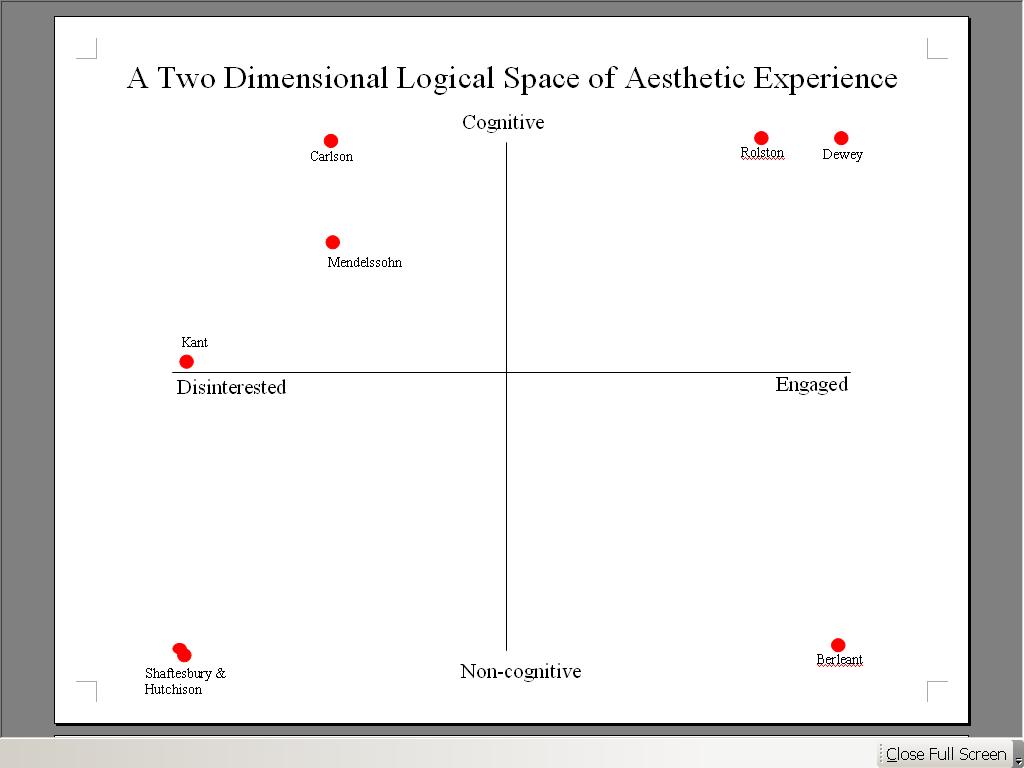
I love making little diagrams like this. I'd like to populate this one with a lot of thinkers and then actually publish it with my article, but it probably wouldn't be scholarly enough.
In any case, I want to put Buddhist nonattachment in the lower left, as a disinterested, noncognitive state. This sounds right if you talk about the dots as "experiential states." But it does't work as well if you say they are "mental states", which is what I did in the last post. Noncognitive mental state doesn't sound right. I suppose I should just change "mental" to "experiential" when I work the material in the last post into the actual essay, but that might make the references to meaning in the head awkward.
Drop the problem and move forward.
We need to zoom in on the lower left corner, look at the notions of disinterestedness that have been held in the western tradition and how they relate to noncognitive experience. Then we need to do the same for nonattachment. Lets start with disinterestedness.
Shaftsbury
kids need reading to
I want to assert that aesthetic disinterestedness, as it has been described in western philosophy since the 18th century, and nonattachment, as it has been has been described in Indian and Buddhist philosophy for thousands of years, name similar mental states. Here's the problem: in talking about aesthetic experience of nature in the western tradition, I distinguished two axes of disagreement. People have argued over whether aesthetic experience is "disinterested" or "engaged" and whether it is "cognitive" or "noncognitive." The cognitive/noncognitive dispute is over whether the aesthetic appreciation of a natural environment, should be guided by ideas from history and natural science or whether it should be free of all guiding narratives. The disinterested/engaged debate is over whether one should feel a personal stake in the object of aesthetic contemplation or view it from a detached perspective. You can then map the position in the debate over the aesthetics of nature onto a two-dimensional space, like this.
I love making little diagrams like this. I'd like to populate this one with a lot of thinkers and then actually publish it with my article, but it probably wouldn't be scholarly enough.
In any case, I want to put Buddhist nonattachment in the lower left, as a disinterested, noncognitive state. This sounds right if you talk about the dots as "experiential states." But it does't work as well if you say they are "mental states", which is what I did in the last post. Noncognitive mental state doesn't sound right. I suppose I should just change "mental" to "experiential" when I work the material in the last post into the actual essay, but that might make the references to meaning in the head awkward.
Drop the problem and move forward.
We need to zoom in on the lower left corner, look at the notions of disinterestedness that have been held in the western tradition and how they relate to noncognitive experience. Then we need to do the same for nonattachment. Lets start with disinterestedness.
Shaftsbury
kids need reading to
ok, I'm writing again
I went with Caroline down to the Rock Beach, a small stretch of sand, garbage, driftwood and stones along Lake Erie near our house. We go to hunt for pretty rocks and "sea glass" (really fragments of old bottles that have been worn smooth by the water.)
Ok, back to work. The idea of nonattachment developed during the axial age of Indian philosophy, from around 800 BCE to the beginning of the common era, an age which saw the writings of the Upanishads and the Bhagavad Gita and the lives of the Buddha and Mahavira. It cannot be traced to particular thinkers interested in promoting particular ideas, the way disinterestedness can, and it was not intended as an account of a single aspect of experience, such as beauty. Instead it was an integral aspect of a program for attaining complete spiritual liberation.
Despite the radically different origins of the two ideas, I maintain that they describe similar mental states. In each case, we are looking at a suspension of means-ends rationality and some form of putting desire on "hold." Admittedly, mental states are a bitch to individuate, and clearly depend on factors that are not "in the head," including social and physical reality (cite annoying twin earth-type research here.) You cannot know what a subject is thinking about simply by looking at the the state of his brain, because the same brain state might mean something different in different social and physical contexts. This means that on one level, the mind of a Hindu Sadhu in deep meditation is obviously going to be in a very different category than the mind of a 18th century contemplating a lovely view of the countryside. Still, we can productively classify mental states based mostly on features that are "in the head", including phenomenological descriptions of the state and, as technology advances, descriptions of physical brain states, using only very general descriptions of external social and physical reality. For instance, we can say that two individuals in very different circumstances are both "fearful," based on their descriptions on how they feel and increased blood flow to, say, the amygdala,1 even though one person is afraid of karmic pollution from touching a dalit and the other a humiliating loss of face in the House of Lords. Similarly, I think that if you focus on the aspects of disinterestedness and nonattachment that are mostly "in the head", you will see a strong resemblance. More importantly, insights into the mental state as it has been described in one tradition can help us understand related states in a different tradition.
___________
1 Whenever I read about the neurological correlates to any interesting mental process, it always seems to involve some combination of the amygdala, the hypothalamus, and the prefrontal cortex. I'm beginning to think that the brain really only has these three parts and that "increased activity in the amydala, hypothalamus, and prefrontal cortex" actually means the same thing as "brain activity." People only substitute "amygdala" for "brain" because it sounds fancy. I used to hear about the hippocampus sometimes, but I think the hypothalamus is the new hippocampus of fake brain science.
Ok, back to work. The idea of nonattachment developed during the axial age of Indian philosophy, from around 800 BCE to the beginning of the common era, an age which saw the writings of the Upanishads and the Bhagavad Gita and the lives of the Buddha and Mahavira. It cannot be traced to particular thinkers interested in promoting particular ideas, the way disinterestedness can, and it was not intended as an account of a single aspect of experience, such as beauty. Instead it was an integral aspect of a program for attaining complete spiritual liberation.
Despite the radically different origins of the two ideas, I maintain that they describe similar mental states. In each case, we are looking at a suspension of means-ends rationality and some form of putting desire on "hold." Admittedly, mental states are a bitch to individuate, and clearly depend on factors that are not "in the head," including social and physical reality (cite annoying twin earth-type research here.) You cannot know what a subject is thinking about simply by looking at the the state of his brain, because the same brain state might mean something different in different social and physical contexts. This means that on one level, the mind of a Hindu Sadhu in deep meditation is obviously going to be in a very different category than the mind of a 18th century contemplating a lovely view of the countryside. Still, we can productively classify mental states based mostly on features that are "in the head", including phenomenological descriptions of the state and, as technology advances, descriptions of physical brain states, using only very general descriptions of external social and physical reality. For instance, we can say that two individuals in very different circumstances are both "fearful," based on their descriptions on how they feel and increased blood flow to, say, the amygdala,1 even though one person is afraid of karmic pollution from touching a dalit and the other a humiliating loss of face in the House of Lords. Similarly, I think that if you focus on the aspects of disinterestedness and nonattachment that are mostly "in the head", you will see a strong resemblance. More importantly, insights into the mental state as it has been described in one tradition can help us understand related states in a different tradition.
___________
1 Whenever I read about the neurological correlates to any interesting mental process, it always seems to involve some combination of the amygdala, the hypothalamus, and the prefrontal cortex. I'm beginning to think that the brain really only has these three parts and that "increased activity in the amydala, hypothalamus, and prefrontal cortex" actually means the same thing as "brain activity." People only substitute "amygdala" for "brain" because it sounds fancy. I used to hear about the hippocampus sometimes, but I think the hypothalamus is the new hippocampus of fake brain science.
I'm writing, I'm writing
The idea of aesthetic disinterestedness was introduced in Western philosophy by Lord Shaftesbury and Francis Hutcheson. Shaftebury's ideas were developed in works he wrote between 1705 and 1710, including Sensus Communis and The Moralists most of which were folded into a summary volume of his life's work,Characteristics of Men, Manners, Opinions, Times (1714). Hutcheson's aesthetic ideas were promulgated in Inquiry concerning Beauty, Order, Harmony and Design (1725). Hutcheson was primarily interested in defending the thesis that beauty was perceived directly by a rational intuition. Shaftesbury's ideas, which came earlier, are harder to classify, but he is still basically concerned with the thesis that the experience of beauty is a perception of divine harmony and order.
The roots of nonattachment in Eastern philosophy are much more diffuse. The idea was already commonplace amongst the spiritual seekers and world-renouncers of India at the time the Buddha began to preach his version of the practice. The primary interest here was not any kind of perception, but the attainment of a mental state that would preclude the build up of Karma, and thus free one from the tyranny of samsara (rebirth). In the Gita, composed between 200 and 500 years before the common era, the nonattachment is used to reconcile the conflict between the need to act in the world and
argh. Kids need attention. And it doesn't take much to get me to play outside with them on a day like today.
In the terms I outline in my paper, they understood the aesthetic experience as being disinterested and noncognitive.
The roots of nonattachment in Eastern philosophy are much more diffuse. The idea was already commonplace amongst the spiritual seekers and world-renouncers of India at the time the Buddha began to preach his version of the practice. The primary interest here was not any kind of perception, but the attainment of a mental state that would preclude the build up of Karma, and thus free one from the tyranny of samsara (rebirth). In the Gita, composed between 200 and 500 years before the common era, the nonattachment is used to reconcile the conflict between the need to act in the world and
argh. Kids need attention. And it doesn't take much to get me to play outside with them on a day like today.
In the terms I outline in my paper, they understood the aesthetic experience as being disinterested and noncognitive.
Buddhist non-attachment and aesthetic disinterestedness--ok, I'm going to write this.
Ok, I have a mental block.
Two and a half years ago, I had a paper accepted to Environmental Values, with a few conditions, mostly that I clarify the relationship between two concepts I employed, Buddhist non-attachment and aesthetic disinterestedness. I estimated that this would require three to five pages of new material. When I am in a groove, I produce about a page of academic prose a day. I should have been able to send this back right away, but I didn't. Whenever I got time away from day to day responsibilities--teaching, parenting, the job market--I spent it on lower prestige projects. (Or in the case of the Buffy paper, negative prestige projects.)
I'm on spring break now. I have no pressing responsibilities until next Sunday. I'm behind on grading, sure, but sometimes other things have to take priority. The upstairs sink is clogged, but we can always brush our teeth in the downstairs sink. The weather is almost spring like, for once, but Molly can take the kids outside--she just got done with one of her big projects.
So I can do this. I can do this. I can do this. Or maybe I'll continuously blog my mental block for five days.
Two and a half years ago, I had a paper accepted to Environmental Values, with a few conditions, mostly that I clarify the relationship between two concepts I employed, Buddhist non-attachment and aesthetic disinterestedness. I estimated that this would require three to five pages of new material. When I am in a groove, I produce about a page of academic prose a day. I should have been able to send this back right away, but I didn't. Whenever I got time away from day to day responsibilities--teaching, parenting, the job market--I spent it on lower prestige projects. (Or in the case of the Buffy paper, negative prestige projects.)
I'm on spring break now. I have no pressing responsibilities until next Sunday. I'm behind on grading, sure, but sometimes other things have to take priority. The upstairs sink is clogged, but we can always brush our teeth in the downstairs sink. The weather is almost spring like, for once, but Molly can take the kids outside--she just got done with one of her big projects.
So I can do this. I can do this. I can do this. Or maybe I'll continuously blog my mental block for five days.
Tuesday, March 03, 2009
Moral Complexity in the Buffyverse
My essay "Moral Complexity in the Buffyverse" is available at Slayage.
Monday, March 02, 2009
Saturday, February 21, 2009
doubleplusgoodthingers bellyfeel truthiness!
For my critical thinking class.
I'm going to use this disclaimer: "The opinions expressed are here for discussion purposes and do not necessarily represent the views of the instructor or the college."
Readings: Orwell, "Politics and the English Language" and chapter 1 and the appendix to 1984.
George Carlin - Soft Language
I'm going to use this disclaimer: "The opinions expressed are here for discussion purposes and do not necessarily represent the views of the instructor or the college."
Readings: Orwell, "Politics and the English Language" and chapter 1 and the appendix to 1984.
George Carlin - Soft Language
Wednesday, February 18, 2009
People are talking about the book I am in!
The website Watchmencomicmovie has put up a thread to discuss Watchmen and Philosophy, a book that I have an essay in. In the thread, people are asked to pose questions which will be put to the book's editor, Mark White, in an upcoming interview. One of the first questions to come up, from EmPiiRe x, is actually about the topic of my essay, deontology and utilitarianism. Annoyingly, EmPiiRe x suggests that we made a mistake I went out of my way to avoid: treating Veidt as a straightforward utilitarian, rather than a megalomaniac who uses utilitarianism to rationalize his actions. I've posted a response you can check out at the end of the thread.
The amount of attention the book is getting is a pleasant surprise. Molly and I went into Borders last weekend and there was a whole display dedicated to Watchmen, including two piles of copies of Watchmen and Philosophy. I've never been in a book that gets displayed like that.
Also interesting this thought on livejournal about the contradiction between Dr. Manhattan's own existence and his professed materialism. (The blogger also mentions the book I'm in!)
The amount of attention the book is getting is a pleasant surprise. Molly and I went into Borders last weekend and there was a whole display dedicated to Watchmen, including two piles of copies of Watchmen and Philosophy. I've never been in a book that gets displayed like that.
Also interesting this thought on livejournal about the contradiction between Dr. Manhattan's own existence and his professed materialism. (The blogger also mentions the book I'm in!)
Monday, February 16, 2009
Wednesday, February 04, 2009
Subscribe to:
Comments (Atom)
