In prepping for class tomorrow I jotted down a list of 12 questions that we can ask about any particular virtue. I imagine others have made better lists of questions and systematically answered them, but still, I thought the list might be useful to teachers of virtue ethics.
What is it?
1. Can you give a pithy definition of it?
2. Is it a form of self control with regard to an emotion?
3. Is it a mean between two extremes?
How does it relate to the other virtues?
4. Is it a special case of another virtue?
5. Does it need to be distinguished from another virtue that it is often confused with?
6. Is there a general class of virtue that it falls under?
What can we learn about this virtue from others?
7. Are there relevant findings in empirical psychology?
8. Do different cultures regard this virtue differently?
9. How have people symbolized or represented this virtue artistically?
How do I cultivate this virtue in my own life?
10. Is this one that I am good at, or one that I need to work on?
11. What happens to people who lack this virtue?
12. What habits can I adopt to cultivate this virtue.
Monday, February 28, 2011


Friday, February 25, 2011
Easing into a story
When authors tell stories, they assume the reader starting at the beginning and going to the end. But that's generally not true for me. Consider how I've absorbed the Harry Potter series so far. Roughly, it breaks down into these steps.
1) Knowing the general cultural buzz and mapping the characters onto standard genre figures. Boy who finds out he's special. Geek girl sidekick. Gandolf figure. Gentle giant.
2) Overhearing Molly read the books to the kids, while I am doing other things. Occasionally I am called on to read portions of the book. I distinctly remember reading the scene where Hagrid shows our heroes his brother in the woods in book 5. This before I know much of anything about the story.
3) Watching all the movies with the family, in order, except for the one that isn't out yet.
4) Getting books 1 and 2 on CD for Christmas. Listening to book 1 while driving around for the holidays. Notice that this is the first time I actually hear a whole book from beginning to end.
5) The present day: Listening attentively every night at bedtime while Molly reads book 5 to the kids and listening to book 2 on CD when I drive to work.
I bet a lot of people learn stories in ways similar to this. Its not introduction, conflict, climax, denouement. Not boy meets girl, boy loses girl, boy gets girl back again. Even now, now that I am trying to get the story in order, I am missing things. I missed a chapter of book five because they read it while I was working, rather than at bedtime.
This seems like it should be significant for aesthetic theory. But I'm not sure how.
In any case, I still don't know what happens in the second half of the last book, so don't tell me.
1) Knowing the general cultural buzz and mapping the characters onto standard genre figures. Boy who finds out he's special. Geek girl sidekick. Gandolf figure. Gentle giant.
2) Overhearing Molly read the books to the kids, while I am doing other things. Occasionally I am called on to read portions of the book. I distinctly remember reading the scene where Hagrid shows our heroes his brother in the woods in book 5. This before I know much of anything about the story.
3) Watching all the movies with the family, in order, except for the one that isn't out yet.
4) Getting books 1 and 2 on CD for Christmas. Listening to book 1 while driving around for the holidays. Notice that this is the first time I actually hear a whole book from beginning to end.
5) The present day: Listening attentively every night at bedtime while Molly reads book 5 to the kids and listening to book 2 on CD when I drive to work.
I bet a lot of people learn stories in ways similar to this. Its not introduction, conflict, climax, denouement. Not boy meets girl, boy loses girl, boy gets girl back again. Even now, now that I am trying to get the story in order, I am missing things. I missed a chapter of book five because they read it while I was working, rather than at bedtime.
This seems like it should be significant for aesthetic theory. But I'm not sure how.
In any case, I still don't know what happens in the second half of the last book, so don't tell me.
Saturday, February 05, 2011
Lovers' Dialogues I (free writing continued)
Panos and Sylvia
Panos Aristocles stands naked, pot bellied, and balding at the window, watching the snow under the street lamp.
Sylvia: Panos, sweetie, step away from the window. Someone will see you.
Sylvia sits up in bed, her back against the wall. She has long since reached the age where her breasts point straight down, and further past the age where she cares.
Panos: Don't worry. We're on the second floor. No one ever looks up.
Sylvia: I wish I knew you when you had your buff, wrestler's body.
Panos, sounding less offended that you would expect: You are looking for younger men now?
Sylvia: No, the current you is beautiful. I was just imagining variations on the theme.
Panos: You want the version with the long permed hair and the silly tights? There's a Mexican version where a wear a mask, too.
Sylvia: They all sound delicious.
Panos: It was a preposterous body I had, muscles built for show. They gave the appearance of strength only. I'm surprised you are interested.
Sylvia: I'm a literature professor. Beauty is my business.
Panos: There was no beauty there, only spectacle. I'm glad I'm out of the business. The Mexican circuit didn't even pay well.
Sylvia: Your body would still speak of who you were. It couldn't help it.
Panos: What are you on about?
Sylvia: ...
Panos: The body doesn't speak anyway. The mouth may form words and the hand may write, but these are accidents. The person speaks with the language.
Sylvia: I think I can see facts about who you are--your personality, your nature--by directly looking at you.
Panos: A preposterous thesis.
He is now seated on the window sill.
Sylvia: Your fat--particularly your arms and shoulders--says "athlete gone to fat" not "lifelong couch potato."
Panos: That's my nature?
Sylvia: It is a part of your history.
Panos: Do better than that. Look at my body and directly perceive a mental property.
Panos is standing straight at the foot of the bed, his shoulders square with Sylvia's.
Sylvia: Your pride is shouting at me. I think I will ignore it and say that I can see your playfulness instead.
Panos: And where is my playfulness? Where did you see it?
Sylvia: You were smirking. Slightly. You still are.
Panos: And how do you know that is playfulness, and not insolence or even a mask for anger?
Sylvia: I said this was direct perception. I don't need to give a reason.
Panos: You see it because of your past experience with me. Because we have played together and you know how I play.
Sylvia: Also your writing. You are the most playful writer working in pure metaphysics and formal ontology.
Panos: See, language!
Sylvia: But what is wrong with that? I'm allowed to use past experience to shape my perception. How could I see otherwise?
Panos: It certainly makes your perception less direct.
Sylvia: Whatever, the fact is I am not simply projecting something I already know onto the appearance of you.
Panos: Yes, you are.
Sylvia: Well, here's an easy case for me. If I saw you with your eyes wide open and your jaw agape, I would be directly perceiving that you are surprised, a mental property about you.
Panos: Actually, I don't believe that either, but in that case, I am the one being weird. Your view here is common sense, so i will stipulate it. Can you get from there to directly perceiving my playfulness.
Sylvia: Easy peasy. The cases are exactly the same. In both cases I might be mistaken, and in both cases I am relying in part on past experience and a well functioning biological system of perception. If one counts as direct perception, the other does too.
Panos: One case is an event and the other a disposition. Anyway, what do you mean by "direct perception" and how do you deal with the problem of error in perception.
Sylvia: Oh Pan, I don't have any fancy philosophical theories. I teach stories about people. Are you just going to stand there, or are you going to come to bed?
Panos: I'm going to stand here.
Sylvia, wrapping a blanket around her shoulders: Suit yourself. Look, all I meant by "direct perception" was that the objects of my perception are the ordinary things they seem to be, such as foolish naked men who won't come to bed. And when I perceive them as having a property, like being tall, or pale or devilishly handsome, it is my perception that gives me knowledge of these facts. I'm actually trying not to be philosophical here. I'm ruling out funny theories about sense data or qualia or whatever that I never understood or cared for anyway.
Wait, don't open your pretty little mouth. I know where you go next. You are going to bring up two cases. In one I see, oh I dunno, a snake. And in the other, I merely think I see a snake, but really I'm just looking at a rope on the ground in dim light. The perceptions in each case are indistinguishable, but the realities are different. From this you conclude not just that perception is different than reality, but that the object of perception is not the object in reality, because the object of perception is the same, but the reality changed.
Panos: A snake, Sylvia?
Sylvia: I've been reading Śaṅkara.
Panos: And yet you hate philosophy.
Sylvia: No, I just hate philosophers.
[To be continued. I need to read about direct perception (Jackson?). I've also written down that I should write about Bernard Williams, Problems of the Self .]
Panos Aristocles stands naked, pot bellied, and balding at the window, watching the snow under the street lamp.
Sylvia: Panos, sweetie, step away from the window. Someone will see you.
Sylvia sits up in bed, her back against the wall. She has long since reached the age where her breasts point straight down, and further past the age where she cares.
Panos: Don't worry. We're on the second floor. No one ever looks up.
Sylvia: I wish I knew you when you had your buff, wrestler's body.
Panos, sounding less offended that you would expect: You are looking for younger men now?
Sylvia: No, the current you is beautiful. I was just imagining variations on the theme.
Panos: You want the version with the long permed hair and the silly tights? There's a Mexican version where a wear a mask, too.
Sylvia: They all sound delicious.
Panos: It was a preposterous body I had, muscles built for show. They gave the appearance of strength only. I'm surprised you are interested.
Sylvia: I'm a literature professor. Beauty is my business.
Panos: There was no beauty there, only spectacle. I'm glad I'm out of the business. The Mexican circuit didn't even pay well.
Sylvia: Your body would still speak of who you were. It couldn't help it.
Panos: What are you on about?
Sylvia: ...
Panos: The body doesn't speak anyway. The mouth may form words and the hand may write, but these are accidents. The person speaks with the language.
Sylvia: I think I can see facts about who you are--your personality, your nature--by directly looking at you.
Panos: A preposterous thesis.
He is now seated on the window sill.
Sylvia: Your fat--particularly your arms and shoulders--says "athlete gone to fat" not "lifelong couch potato."
Panos: That's my nature?
Sylvia: It is a part of your history.
Panos: Do better than that. Look at my body and directly perceive a mental property.
Panos is standing straight at the foot of the bed, his shoulders square with Sylvia's.
Sylvia: Your pride is shouting at me. I think I will ignore it and say that I can see your playfulness instead.
Panos: And where is my playfulness? Where did you see it?
Sylvia: You were smirking. Slightly. You still are.
Panos: And how do you know that is playfulness, and not insolence or even a mask for anger?
Sylvia: I said this was direct perception. I don't need to give a reason.
Panos: You see it because of your past experience with me. Because we have played together and you know how I play.
Sylvia: Also your writing. You are the most playful writer working in pure metaphysics and formal ontology.
Panos: See, language!
Sylvia: But what is wrong with that? I'm allowed to use past experience to shape my perception. How could I see otherwise?
Panos: It certainly makes your perception less direct.
Sylvia: Whatever, the fact is I am not simply projecting something I already know onto the appearance of you.
Panos: Yes, you are.
Sylvia: Well, here's an easy case for me. If I saw you with your eyes wide open and your jaw agape, I would be directly perceiving that you are surprised, a mental property about you.
Panos: Actually, I don't believe that either, but in that case, I am the one being weird. Your view here is common sense, so i will stipulate it. Can you get from there to directly perceiving my playfulness.
Sylvia: Easy peasy. The cases are exactly the same. In both cases I might be mistaken, and in both cases I am relying in part on past experience and a well functioning biological system of perception. If one counts as direct perception, the other does too.
Panos: One case is an event and the other a disposition. Anyway, what do you mean by "direct perception" and how do you deal with the problem of error in perception.
Sylvia: Oh Pan, I don't have any fancy philosophical theories. I teach stories about people. Are you just going to stand there, or are you going to come to bed?
Panos: I'm going to stand here.
Sylvia, wrapping a blanket around her shoulders: Suit yourself. Look, all I meant by "direct perception" was that the objects of my perception are the ordinary things they seem to be, such as foolish naked men who won't come to bed. And when I perceive them as having a property, like being tall, or pale or devilishly handsome, it is my perception that gives me knowledge of these facts. I'm actually trying not to be philosophical here. I'm ruling out funny theories about sense data or qualia or whatever that I never understood or cared for anyway.
Wait, don't open your pretty little mouth. I know where you go next. You are going to bring up two cases. In one I see, oh I dunno, a snake. And in the other, I merely think I see a snake, but really I'm just looking at a rope on the ground in dim light. The perceptions in each case are indistinguishable, but the realities are different. From this you conclude not just that perception is different than reality, but that the object of perception is not the object in reality, because the object of perception is the same, but the reality changed.
Panos: A snake, Sylvia?
Sylvia: I've been reading Śaṅkara.
Panos: And yet you hate philosophy.
Sylvia: No, I just hate philosophers.
[To be continued. I need to read about direct perception (Jackson?). I've also written down that I should write about Bernard Williams, Problems of the Self .]
Tuesday, December 28, 2010
Authority and Inequality
In this podcast, Alex Voorhoeve points out that one important problem with inequality is that it gives one person power over another. The problem isn't just that you are rich and I am poor, but that as a result of this, you can fuck with me. I do more than resent your success, I fear for my safety.
Over the last few years, I've grown into the habit of thinking of the moral emotions in terms of Haidt's five fold system, and as a part of this, I thought of all issues of equality and all sorts of Rawlsian concerns as matters of fairness. If one person is rich and one is poor, this is a problem for the "fairness/reciprocity" set of instincts which liberals recognize. But a lot of times that's not the problem. The problem is with the authority/hierarchy instincts. These are instincts that conservatives think of as moral, but liberals are indifferent to. Conservatives believe that obedience and dereference to your betters are good, while liberals think that all urges toward obedience are irrational and should be expelled.
So here's my big revelation: the authority/hierarchy instincts are not just amoral. They are immoral. They aren't just irrelevant for moral thinking. They systematically lead us astray.
If this is right, it is big. The typical liberal critique of the conservative moral emotions is that they are prejudices. The big example here are the moral emotions associated with purity and sanctity, which include the feelings of disgust we have at people whose sexual practices violate our rules. Liberals tend to reject these instincts, which is all well and good when it comes to accepting gays, but is harder to when it comes to rejecting instincts against incest.
Personally, I do accept the moral importance of some purity instincts, including the instinct against incest. But I want to go farther than simply rejecting the moral importance of the authority/hierarchy instinct. It is not just mistaken. It is systematically the opposite of true.
Ok, now I've written that. I'll see if I believe it in the morning.
Over the last few years, I've grown into the habit of thinking of the moral emotions in terms of Haidt's five fold system, and as a part of this, I thought of all issues of equality and all sorts of Rawlsian concerns as matters of fairness. If one person is rich and one is poor, this is a problem for the "fairness/reciprocity" set of instincts which liberals recognize. But a lot of times that's not the problem. The problem is with the authority/hierarchy instincts. These are instincts that conservatives think of as moral, but liberals are indifferent to. Conservatives believe that obedience and dereference to your betters are good, while liberals think that all urges toward obedience are irrational and should be expelled.
So here's my big revelation: the authority/hierarchy instincts are not just amoral. They are immoral. They aren't just irrelevant for moral thinking. They systematically lead us astray.
If this is right, it is big. The typical liberal critique of the conservative moral emotions is that they are prejudices. The big example here are the moral emotions associated with purity and sanctity, which include the feelings of disgust we have at people whose sexual practices violate our rules. Liberals tend to reject these instincts, which is all well and good when it comes to accepting gays, but is harder to when it comes to rejecting instincts against incest.
Personally, I do accept the moral importance of some purity instincts, including the instinct against incest. But I want to go farther than simply rejecting the moral importance of the authority/hierarchy instinct. It is not just mistaken. It is systematically the opposite of true.
Ok, now I've written that. I'll see if I believe it in the morning.
Tuesday, December 07, 2010
test driving free plagiarism detection software.
I just caught a student cheating, so now is a good opportunity to check the various free plagiarism detection services which are out there. Using Google, I've found one online source which is a close match for one of the student's paragraphs. I want to see whether the free online services will be able to find the match I found and match the rest of the document. I am particularly interested in output: I'd like to see side-by-side comparisons of the paper and the original source, with the matching passages marked. This is what I did for the one paragraph match I found
If you have comparisons like this for the whole document, you are pretty much justified in throwing the book at the student. I have redacted the student's name, which is what I believe is required by FERPA.
See Sources Seesources.com
This page is a freebie teaser for a pay version called Plagscan, which costs about a penny a page and is available at plagscan.com. It lets you upload your whole file as an attachment, rather than cutting and pasting paragraphs into a little field. The nice looking output is reserved for paying customers. What I got looks like this.
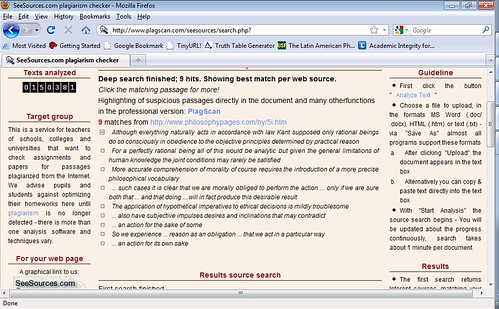
The software caught matches I did not, but it only caught direct quotes, and not slight paraphrases like "Hypothetical Imperatives conditionally demand" for "A hypothetical imperative conditionally demands." You could use these to get to the rest of the copying, though. More interestingingly, at a penny a page, blanket coverage for me would only cost $5-$10 a semester, which I could pay out of pocket.
Plagium
Didn't catch anything. FAIL.
Plagiarism Checker.
Produced by the University of Maryland Department of Education. This is again a free teaser for a subscription product, which at $8 a month is again something I could pay out of pocket. The whole thing is Google driven, and when it finds a hit, it just gives you links to a Google search for the exact phrase it hit on. The subscription version will let you upload files directly and will ignore material in quotes. If this is all it adds, it doesn't seem worth it. Output below.
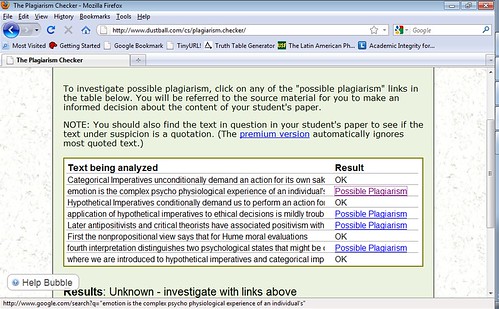
Ok, the kids are freaking out. I'll finish this later. I need to check these two.
Copy Tracker
copytracker.ec-lille.fr
Chimpsky.
http://chimpsky.uwaterloo.ca/
If you have comparisons like this for the whole document, you are pretty much justified in throwing the book at the student. I have redacted the student's name, which is what I believe is required by FERPA.
See Sources Seesources.com
This page is a freebie teaser for a pay version called Plagscan, which costs about a penny a page and is available at plagscan.com. It lets you upload your whole file as an attachment, rather than cutting and pasting paragraphs into a little field. The nice looking output is reserved for paying customers. What I got looks like this.
The software caught matches I did not, but it only caught direct quotes, and not slight paraphrases like "Hypothetical Imperatives conditionally demand" for "A hypothetical imperative conditionally demands." You could use these to get to the rest of the copying, though. More interestingingly, at a penny a page, blanket coverage for me would only cost $5-$10 a semester, which I could pay out of pocket.
Plagium
Didn't catch anything. FAIL.
Plagiarism Checker.
Produced by the University of Maryland Department of Education. This is again a free teaser for a subscription product, which at $8 a month is again something I could pay out of pocket. The whole thing is Google driven, and when it finds a hit, it just gives you links to a Google search for the exact phrase it hit on. The subscription version will let you upload files directly and will ignore material in quotes. If this is all it adds, it doesn't seem worth it. Output below.
Ok, the kids are freaking out. I'll finish this later. I need to check these two.
Copy Tracker
copytracker.ec-lille.fr
Chimpsky.
http://chimpsky.uwaterloo.ca/
Friday, December 03, 2010
Scholars of the Valley.
The Grand Mother-Empress summoned the greatest scholars of the River, the impuritans of the lower valley and the Maximalists of the upper valley, to debate her divinity. Privately, she hoped she was not divine.
The impuritans, charged with negative position, sent as their first arguer, a boy of eleven. Boy-of-eleven was quite a prodigy, to be sure, but no one expected him to win an imperial debate. The Maximalists clearly didn't expect him to win, as they sent out an over-the-hill back bencher, who was scarcely an imperial class arguer when he was in his prime. Looking uncomfortable in a brand new formal suit, Boy-of-Eleven looked like he had just come from his manhood ceremony, which would in fact not be for two more years. Back-Bencher wore the suit he wore when he won his most famous argument, some twenty years ago.
"Hey kid. Don't think for a moment that I'm going to take it easy on you because your a kid." Back-Bencher said as the two shook hands.
The kid won the toss, and got to choose the style of argument. "Dissent" he called. "I'll take the skeptical position." This was a safe move for him. In a dissent all the skeptic has to do is prove that the positive side has not made its case. In a debate, by contrast, both sides have positions they are trying to prove, and it is possible for the argument to end in a tie.
"Inductive reasoning," Back-Bencher replied, "from plausible premises." He was, at least, not simply handing the boy the match. If he had called for deductive reasoning or self evident premises, he would have a harder row to hoe. Perhaps he knew his limitations.
"I assert the divinity of the grand Mother-Empress," declared the Back-Bencher, "and as evidence I offer the prosperity of the valley."
With this opening move, the grand Mother-Empress sighed, not loudly, but enough that that she could be heard by her chief advisor on her left and her eldest son on her right.
The impuritans, charged with negative position, sent as their first arguer, a boy of eleven. Boy-of-eleven was quite a prodigy, to be sure, but no one expected him to win an imperial debate. The Maximalists clearly didn't expect him to win, as they sent out an over-the-hill back bencher, who was scarcely an imperial class arguer when he was in his prime. Looking uncomfortable in a brand new formal suit, Boy-of-Eleven looked like he had just come from his manhood ceremony, which would in fact not be for two more years. Back-Bencher wore the suit he wore when he won his most famous argument, some twenty years ago.
"Hey kid. Don't think for a moment that I'm going to take it easy on you because your a kid." Back-Bencher said as the two shook hands.
The kid won the toss, and got to choose the style of argument. "Dissent" he called. "I'll take the skeptical position." This was a safe move for him. In a dissent all the skeptic has to do is prove that the positive side has not made its case. In a debate, by contrast, both sides have positions they are trying to prove, and it is possible for the argument to end in a tie.
"Inductive reasoning," Back-Bencher replied, "from plausible premises." He was, at least, not simply handing the boy the match. If he had called for deductive reasoning or self evident premises, he would have a harder row to hoe. Perhaps he knew his limitations.
"I assert the divinity of the grand Mother-Empress," declared the Back-Bencher, "and as evidence I offer the prosperity of the valley."
With this opening move, the grand Mother-Empress sighed, not loudly, but enough that that she could be heard by her chief advisor on her left and her eldest son on her right.
Monday, November 15, 2010
Free writing
That Fred believed a combination nursing home and whorehouse was a splendid idea would surprise no one who knew him. It was somewhat more surprising that he could find so many RNs who were also experienced prostitutes. It was genuinely alarming that he had gotten this far along in the loan application process at one of the largest banks operating in Nevada. "Health care and sex work have a lot in common both in terms of the skills you have to bring to them and the outcomes you can expect with the clients," he said to the assembled skeptical faces.
Free writing
Silk Worm Moon had decided that it was time to bring the religion of The Users out of the fictional world of Tron and into the real world. Having worked in translation of one sort or another all her life, this seemed a natural thing to her. It helped a lot that philosophers were now regarding the idea that we live in a computer simulation to be a live possibility, rather than a skeptical hypothesis. She thought about bringing the religion to some of the corners of the internet she knew where such proposals are received with exactly the level of seriousness she had. She worried, though, that the voices there would have questions about the video game, the comic book, or the new movie. A user, she thought, would be a kind of semi-demi-urge: not ultimate creator, nor the creator of this world, merely someone who had customized this portion of the world to suit his needs. A city god, or tribal god. A guardian spirit or animal guide. Should she first show that the world is really a computer simulation? She didn't want this project to end like her youthful attempt to recreate the Pythagorean cult. Most of all, she needed to know what her user wanted her to do.
Sunday, November 14, 2010
Free Writing
In recent ship-wide elections, the Conservative Party gained control of the starboard engine, and have vowed to shut it down. If Labor, which retains control of the port engine, decides to massively increase thrust, the ship may start traveling in tiny circles. However, the most politically likely outcome is that the massive asteroid vessel will fly straight into the sun.
Saturday, November 13, 2010
Free writing
"Ha ha!" cried the villain, "with this device I shall go all the way back in time, to the very beginning, and change it so the universe as a whole never existed!"
Friday, November 12, 2010
Free Writing
The Grand Mother-Empress summoned the greatest scholars of the River, the impuritans of the lower valley and the Maximalists of the upper valley, to debate her divinity. Privately, she hoped she was not divine.
Thursday, November 11, 2010
Free Writing
The people of his planet had large hands that were extremely sensitive. Indeed, their language had a hand-holding form, in addition to a spoken and a written form. The cost of this sensitivity was that the hands must be kept extremely cold, about 20 degrees colder than human body temperature, a fact that Captain Patel found very inconvenient whenever she was in a relationship with one, which was surprisingly often.
Thursday, October 21, 2010
Time to Vote!
Again, here are the much coveted Helpy-Chalk endorsements. This election we are also pushing early voting. By voting now you can save the Dems much needed money on turning out other voters later.
Also, this esteemed blog is recommending judge4yourself.com for information on the down-ticket judicial races no one ever seems to know about.
And now the endorsements: For every state and national level office & the county council race: The Democrat.
For Cuyahoga County Executive: Tim McCormack. He's a longtime Dem running as an independent because of the corruption of the local party. He sounded very good in his WCPN interview.
Chief Justice of the Supreme Court: Eric Brown (over Maureen O'Conner). This is a race between two sitting judges to see who will be chief justice. The court itself is an embarrassment, that frequently rules in favor of large corporate donors to the campaigns of the judges. The very fact that judges are allowed to rule on cases involving donors is a disgrace that has been featured in the New York Times.
For a long time before Brown was appointed, the court has been all Republican. Brown was appointed by Strickland after the former Chief justice died. He has been endorsed by the Plain Dealer and Call and Post and gets higher ratings from the local bar associations. I'm just hoping that as an outsider to the court appointed by a Democrat, he is more likely to push against the corruption.
Justice of the Supreme Court: Mary Jane Trapp (over Judith Lanzinger) See above for the background. Lanzinger is the incumbent in this bad system. Trap gets better ratings from the bar associations and has the recommendation of the Call and Post. The PD went with Lanzinger, but I distrust their endorsements.
8th district court of appeals: Kathleen Ann Keough and Eileen Gallagher, based on judge4yourself rating.
Judge of the Court of Common Pleas Lance Timothy Mason (over Baker), on judge4yourself ratings
Judge of the Court of Common Pleas Dick Ambrose (over Hall), This is one of those places where the judge4yourself ratings are very helpful. Ambrose's opponent received a "not recommended" from all four local bar associations, a sign of serious incompetence or corruption.
Judge of the Court of Common Pleas McClelland (over Clancy). McClelland has all excellent ratings from the local bars, but the newspapers went with Clancy. I decided to trust the bars, on the grounds that at this level simple legal competence is more important than political connections. Also, the bar associations listed include the associations for women, African Americans, and defense lawyers, so I feel the less powerful are represented.
Judge of the Court of Common Pleas Michael Astrab. His opponent, Bridget McCafferty has been indicted in the corruption arrests that have swept the county but still might when the election because women with Irish last names do well around here.
Judge of the Court of Common Pleas Rosemary Grdina Gold (over Marshall). Marshall's ratings are so bad it is natural to suspect incompetence or corruption.
Issue 1: Money for the public schools: YES. Always vote for the schools.
Issue 2: Allow attached housing in some business districts Yes. Sounds like it would be good for walkability.
Also, this esteemed blog is recommending judge4yourself.com for information on the down-ticket judicial races no one ever seems to know about.
And now the endorsements: For every state and national level office & the county council race: The Democrat.
For Cuyahoga County Executive: Tim McCormack. He's a longtime Dem running as an independent because of the corruption of the local party. He sounded very good in his WCPN interview.
Chief Justice of the Supreme Court: Eric Brown (over Maureen O'Conner). This is a race between two sitting judges to see who will be chief justice. The court itself is an embarrassment, that frequently rules in favor of large corporate donors to the campaigns of the judges. The very fact that judges are allowed to rule on cases involving donors is a disgrace that has been featured in the New York Times.
For a long time before Brown was appointed, the court has been all Republican. Brown was appointed by Strickland after the former Chief justice died. He has been endorsed by the Plain Dealer and Call and Post and gets higher ratings from the local bar associations. I'm just hoping that as an outsider to the court appointed by a Democrat, he is more likely to push against the corruption.
Justice of the Supreme Court: Mary Jane Trapp (over Judith Lanzinger) See above for the background. Lanzinger is the incumbent in this bad system. Trap gets better ratings from the bar associations and has the recommendation of the Call and Post. The PD went with Lanzinger, but I distrust their endorsements.
8th district court of appeals: Kathleen Ann Keough and Eileen Gallagher, based on judge4yourself rating.
Judge of the Court of Common Pleas Lance Timothy Mason (over Baker), on judge4yourself ratings
Judge of the Court of Common Pleas Dick Ambrose (over Hall), This is one of those places where the judge4yourself ratings are very helpful. Ambrose's opponent received a "not recommended" from all four local bar associations, a sign of serious incompetence or corruption.
Judge of the Court of Common Pleas McClelland (over Clancy). McClelland has all excellent ratings from the local bars, but the newspapers went with Clancy. I decided to trust the bars, on the grounds that at this level simple legal competence is more important than political connections. Also, the bar associations listed include the associations for women, African Americans, and defense lawyers, so I feel the less powerful are represented.
Judge of the Court of Common Pleas Michael Astrab. His opponent, Bridget McCafferty has been indicted in the corruption arrests that have swept the county but still might when the election because women with Irish last names do well around here.
Judge of the Court of Common Pleas Rosemary Grdina Gold (over Marshall). Marshall's ratings are so bad it is natural to suspect incompetence or corruption.
Issue 1: Money for the public schools: YES. Always vote for the schools.
Issue 2: Allow attached housing in some business districts Yes. Sounds like it would be good for walkability.
Sunday, October 17, 2010
Should people give final exams?
The Boston Globe has a piece up about the declining use of final exams, and In Socrates' Wake responds with more general thoughts about frequent, low-stakes testing vs. infrequent high-stakes testing, as a part of their ongoing discussion of the issue. I have long been on the frequent, low-stakes side, which mostly means I spend a lot of time shuffling paper. ISW comes down in favor of retaining some role for the final exam, but everything I'm seeing here reinforces the idea that frequent low-stakes testing is the way to go.
The Globe article was prompted by a change in Harvard's policy about scheduling finals. Rather than assuming that every class will have a final, and them booking a room for it which may go unused, Harvard now requires instructors to request a room for a final. This decision in tern was prompted by the discovery that only 23% of the classes at Harvard actually have finals. (This, by the way, is a change that LCCC might want to consider as well. Our inefficient room scheduling has been cited by outside consultants as a place where we might save money, and our finals scheduling has often been a mess, with rooms double booked.)
I know there is research out there backing the frequent, low-stakes side, but I've never really delved into it. The Globe article one cites on empirical study, by M. Vali Siadat, which showed that algebra students who were given small weekly quizzes did better overall, and on the final exams, than those who were given less rigorous weekly assignments. (This makes me feel good about the structure of my logic class.) This is the original study. A commenter at ISW also mentions the spacing effect, which shows that periodic reinforcement over a long period of time leads to better memory than short cramming sessions. This, by the way, has been known since 1885.
Michael Cholbi at ISW suggests that the frequent low-stakes vs. infrequent high-stakes may a be a false dichotomy. Indeed, the Siadat study seems to have really been about two different versions of the mixed approach, with the winning strategy leaning more to the frequent low-stakes side. My logic class follows roughly that structure, with 10 short quizzes (down from 15 in a 15 week course.) In place of a final, you are allowed to re-take 3 of your quizzes. I think this definitely works for math-like subjects. The issue is more complicated for the humanities.
The Globe article was prompted by a change in Harvard's policy about scheduling finals. Rather than assuming that every class will have a final, and them booking a room for it which may go unused, Harvard now requires instructors to request a room for a final. This decision in tern was prompted by the discovery that only 23% of the classes at Harvard actually have finals. (This, by the way, is a change that LCCC might want to consider as well. Our inefficient room scheduling has been cited by outside consultants as a place where we might save money, and our finals scheduling has often been a mess, with rooms double booked.)
I know there is research out there backing the frequent, low-stakes side, but I've never really delved into it. The Globe article one cites on empirical study, by M. Vali Siadat, which showed that algebra students who were given small weekly quizzes did better overall, and on the final exams, than those who were given less rigorous weekly assignments. (This makes me feel good about the structure of my logic class.) This is the original study. A commenter at ISW also mentions the spacing effect, which shows that periodic reinforcement over a long period of time leads to better memory than short cramming sessions. This, by the way, has been known since 1885.
Michael Cholbi at ISW suggests that the frequent low-stakes vs. infrequent high-stakes may a be a false dichotomy. Indeed, the Siadat study seems to have really been about two different versions of the mixed approach, with the winning strategy leaning more to the frequent low-stakes side. My logic class follows roughly that structure, with 10 short quizzes (down from 15 in a 15 week course.) In place of a final, you are allowed to re-take 3 of your quizzes. I think this definitely works for math-like subjects. The issue is more complicated for the humanities.
Subscribe to:
Posts (Atom)
